What does lavender marriage mean?
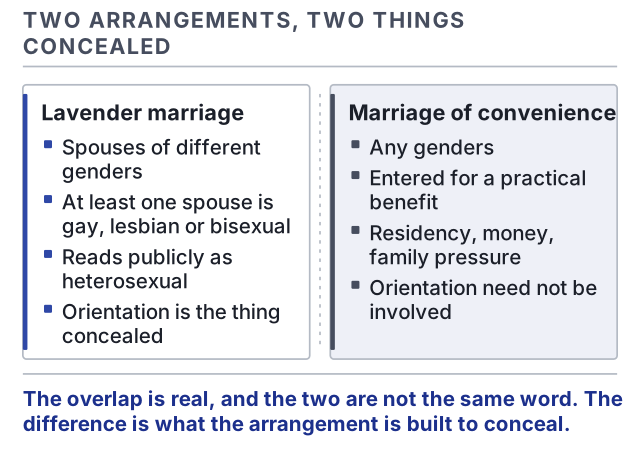
Lavender marriage is the name for a marriage between people of different genders in which at least one spouse is gay, lesbian, or bisexual. The marriage works in public as a straight one. It shields a career, a reputation, a family standing, or personal safety.
The lavender marriage meaning sits in the reason, not in the feelings. Such a marriage can be warm, friendly, or purely practical. What makes the term apply is that the marriage does public work as a straight marriage while at least one spouse is not straight. Nothing in the phrase says whether the spouses live together, share a bed, or love each other.
The word describes; it does not accuse. Historians and journalists apply it to arrangements people made in places where being openly queer carried a job cost or a legal one. When the two-word phrase itself was first written down is not established. Wordorigins’ big-list entry for lavender defines the compound but carries no dated citation for it, so this entry gives no year.
What does a lavender marriage look like in use?
In use, the phrase turns up in historical writing, in family stories, and in accounts of communities today. Consider three scenes, offered as illustrations of how the phrase is used, not as guidance:
- A film historian writes that a studio “arranged a lavender marriage” for a contract actor. The sentence is about the studio’s press machinery, not about romance.
- Someone posts about grandparents whose marriage the family later understood differently. The comments supply the term as the name for what is being described.
- A person in a strict religious community marries someone of another gender, and both spouses know what the arrangement is. Writing about that situation reaches for the same phrase, carried over from Hollywood history to the present.
A fourth use is looser and worth flagging. Online, “lavender marriage” is sometimes thrown at any public couple whose chemistry looks staged. That use is guesswork about named people dressed up as a term. It is not what the phrase means.
Where does the phrase lavender marriage come from?
The phrase belongs to writing about the English-language film world of the early-to-mid twentieth century. Studio press offices ran the private lives of people under contract, and an openly gay performer was a business risk. Gossip columns and industry insiders needed a discreet name for a marriage staged to answer questions before they were asked.
The colour did the discreet part. Lavender was already a coded reference to queerness in English slang before the marriage compound formed. It survives in phrases about a “lavender streak,” and the colour sense is recorded in Green’s Dictionary of Slang. Where the colour association itself began is not settled, and this entry does not invent a source for it.
What can be said plainly is this. The phrase belongs to one era of press management. Historians later picked it up to describe that era. It has since been stretched to cover arrangements outside the film world. Exact first-use years circulate in retellings without agreement, so no year is given here.
What is a lavender marriage confused with?
A lavender marriage is confused most often with the broader marriage of convenience, with the green card marriage, and with the beard. Those terms are about benefit, documents and roles.
| Term | What it names | How it differs |
|---|---|---|
| Lavender marriage | A marriage that publicly reads as straight while a spouse is not | — |
| Marriage of convenience | Any marriage entered for a practical benefit | Broader category; the benefit need not involve orientation |
| Green card marriage | A marriage entered for immigration status | The benefit is a document, not a public image |
| Beard | A person who provides the cover | Names one role, and need not involve marriage at all |
| Companionate marriage | A marriage built on partnership rather than romance | Describes the content of the marriage, not a public cover story |
Marriage of convenience refers to any marriage entered for a practical benefit, such as money, citizenship, or status. A lavender marriage is the subset where the benefit is a straight public face.
Beard is the closest neighbour, and it names a person rather than an arrangement. A beard can be a date for one evening. A lavender marriage is a legal marriage. The two words often sit in the same paragraph, which is why they blur.
The second frequent swap is with platonic partnership. Platonic marriage is the name for a marriage without a sexual side. That is a statement about what happens inside it. A lavender marriage is a statement about what the marriage projects outward. An arrangement can be one, the other, both, or neither.
Worth separating too: a lavender marriage is not a departure from monogamy by definition. Some are monogamous in practice. Some involve agreed outside relationships. The term settles neither question.
What lavender marriage does not mean
This is the boundary, and it is the part that does the most work.
It does not mean the marriage is fake. In law it is a marriage. The arrangement is compatible with real partnership, a shared household and children. “Fake marriage” describes a document problem. This phrase describes a public-facing reason.
It does not mean deception between the spouses. In the classic sense both people know exactly what the arrangement is. The cover is aimed at employers, audiences, neighbours, and family, not at each other.
It does not mean sexless. Nothing in the definition speaks to what happens between the spouses. Assuming it does is where the confusion with asexuality begins. The two describe different things. One names a public arrangement. The other is how a person describes their own attraction.
It does not mean loveless. Nothing in the definition rules out affection, friendship or lifelong loyalty.
It is not a label to place on other people. Applied from outside, the phrase makes a claim about a named person’s orientation from appearances. A historian making that claim works from letters, testimony and admissions, and still hedges. A comment section has none of that.
It is not a synonym for a closeted person. Being closeted describes concealment. A lavender marriage is one structure that concealment has taken.
Where this page stops
This is a dictionary entry. It explains a term and its history. It does not advise anyone on entering such a marriage, leaving one, or discussing one with a spouse. It does not help anyone work out whether a public figure is in one.
Marriages entered under pressure from family, community, or an employer can involve coercion. That is beyond what a glossary can address. A licensed therapist or counsellor, a lawyer, or a helpline is the right route. In some places LGBTQ+ organisations run those lines directly.
The rest of the vocabulary for relationship statuses and formats lives in the status and formats section.
Checked: August 26, 2026. Status: current — a historical term in continuing use, with an active looser sense online that this entry treats as separate from the definition.