What does exclusive mean in dating?
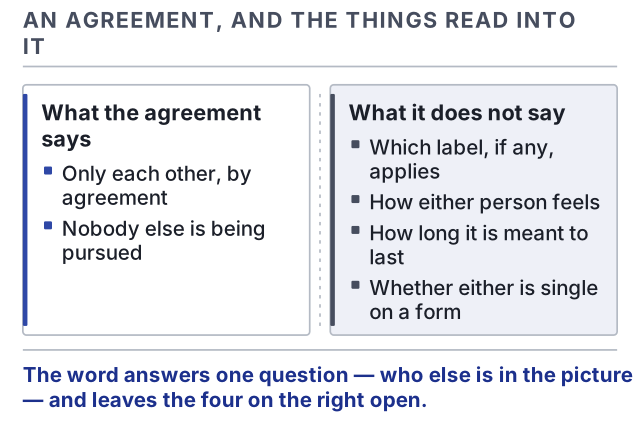
In dating, exclusive means two people have agreed to date only each other and to stop seeing or pursuing anyone else. The word names an agreement about scope: who else is in the picture, and the answer is nobody. It does not name a feeling, a title, or a stage.
Everything the word carries follows from that. It is a rule two people set, so it has a point in time when it was set. It can also exist without any label attached to the people who set it. Not to be confused with the commercial sense of exclusive, as in an exclusive interview or an exclusive club. There the word means restricted access. The dating sense is about mutual scope, not scarcity or status.
What does being exclusive look like in use?
Being exclusive shows up in speech as a report about an agreement already made. Consider four ordinary sentences, offered as illustrations rather than instructions:
- Someone says “we’re exclusive but not official.” Two separate things are being reported: the rule is in place, the title is not. In current usage that sentence is not a contradiction. It is one of the most common uses of the word.
- A dating profile reads “looking for something exclusive.” Here the word works as a shorthand for intent. The writer wants an arrangement with one person, rather than seeing several at once.
- After a few months, one person says “so are we exclusive?” The question asks for the agreement to be stated out loud. That is the only way the word applies. It is the same move named by DTR, narrowed to one topic.
- A friend reports “we became exclusive in the spring.” Used this way, the word marks a date on a timeline. It works the way going steady once did.
A fifth use runs the other direction. “Exclusively dating” appears on apps as a self-description, beside options like monogamous or open to non-monogamy. In that slot the word names a preferred format before any specific person is involved.
Where does the dating sense of exclusive come from?
The dating sense grew out of a much older commercial one. The word entered English from Latin excludere, “to shut out,” as Etymonline’s entry for exclusive records. For centuries it did its work in commercial and social senses: exclusive rights, exclusive membership. The relationship use — seeing each other exclusively — applied that same shutting-out logic to other suitors. It reads as a plainer successor to earlier American courtship terms such as going steady.
The precise decade in which exclusive became the standard word for this agreement is not established, and this entry records no coiner: the dating use looks like an extension of ordinary English rather than a coinage traceable to one publication, community or platform. What is visible is a shift in emphasis. Courting vocabulary faded. App dating made seeing several people at once ordinary and visible. The moment of narrowing gained weight, and the word for it — becoming exclusive — hardened into a fixed phrase.
What is exclusivity confused with?
Exclusivity is confused most often with official, monogamous, committed and serious. Those words are about audience, structure, intention and weight rather than about partner count.
| Term | What it names | How it differs from exclusive |
|---|---|---|
| Exclusive | An agreement to see only each other | — |
| Official | Using a label publicly, or with friends and family | A title and an audience; exclusivity needs neither |
| Monogamous | One partner at a time as an ongoing structure | Describes the shape long-term, not a decision point |
| Committed | Intention to keep going | About duration and intent, not partner count |
| Serious | A judgement of weight or stakes | Subjective; exclusivity is a yes-or-no rule |
The closest neighbour is monogamy, and the difference is one of frame. Exclusivity is usually spoken of as an event: the conversation, the agreement, the date it happened. Monogamy is the name for one partner at a time as an ongoing structure. It is spoken of as a state a relationship is in. The same couple can accurately be described with both words at different moments.
The second swap is exclusive for official. Official refers to who else knows, while exclusivity is about who else is involved. For instance, a couple can be exclusive and unannounced. Another couple can be publicly labelled while defining the rule loosely. The two axes move on their own, which is why people invented a sentence that uses both.
The third confusion is with undefined arrangements. A situationship is often described as the absence of exclusivity. This glossary mentions that term only for contrast, since it is covered in depth elsewhere. The sharper contrast is the absence of any stated agreement at all. Exclusivity is defined by having been agreed. The other word is defined by the lack of definition.
What exclusive does not mean
This is the boundary of the term, and it is the part worth reading twice.
It does not mean a label. Exclusive describes an arrangement, while boyfriend, girlfriend and partner are titles applied to people. Neither one produces the other automatically.
It does not mean love. The word is silent about feeling. Two people can be exclusive early, cautiously, and without either having said anything about how they feel.
It does not specify scope on its own. Dating exclusively, sleeping with one person only, and deleting the apps are three different rules. The same word is used for all three. The word inherits whatever scope the pair gave it. Where they gave it none, the word is ambiguous by construction.
It does not mean permanent. An exclusivity agreement is dated, and it can be revised or ended. A relationship that stopped being exclusive was still exclusive while the agreement stood.
It does not mean the same thing in every scene. In non-monogamous vocabulary, exclusive is sometimes qualified: fluid-bonded, emotionally exclusive, exclusive with named exceptions. Those qualifiers show what the base word does. It holds a specific agreement rather than a fixed set of rules.
It is not a stage everyone passes through. Plenty of relationships never use the word. Some go from dating straight to a label or to living together. The absence of the word says nothing about the relationship’s shape. It only means this vocabulary was not used.
Where this page stops
This is a dictionary entry. It defines the word and shows how people use it. It does not advise on when to ask for exclusivity or how to phrase the conversation. It does not say what to conclude if someone declines, or how to read another person’s intentions. Those are matters of judgement, not of definition, and no glossary can settle them.
Sometimes an agreement is enforced through monitoring, pressure, or threats. That is outside what a vocabulary page can address. A licensed therapist or counsellor, or a helpline, is the right place for it.
The status and formats section holds the neighbouring words for stages, statuses and formats. The full A–Z index lists every entry.
Checked: August 26, 2026. Status: current — in continuous everyday use, with the “exclusive but not official” sense now standard rather than novel.