About datingglossary
This page last updated
A dictionary of modern dating terms: what each word means, where it came from, what it is confused with, and when it was last checked.
This is a reference, not a magazine. A reader arrives with one word and leaves with one answer, and every decision on the site follows from that: the front page is the index rather than a set of headlines, the entries are short and identically shaped, and each one carries the month a human last went over it.
datingglossary is written and maintained as an anonymous editorial project: no bylines, no invented authors, no borrowed credentials. That is deliberate. A definition does not become more true because a name is attached to it, and a name that cannot be checked adds nothing but the appearance of authority. What can be checked is what the pages stand on: named sources, a stated boundary for every word, and a date.
What an entry claims, and what it does not
This is the whole editorial position, and it is worth stating before anything else. The left-hand column is what a page here is prepared to defend. The right-hand column is what no page here will say, however often the question is asked.
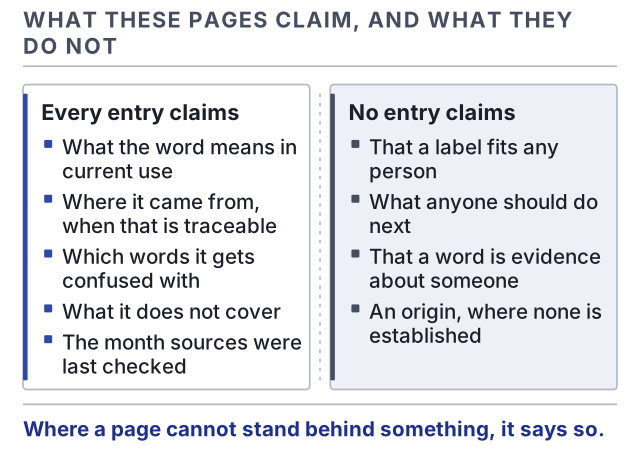
The practical consequence is that some questions get a refusal rather than an answer. Whether a particular person is breadcrumbing you, whether a label fits your partner, what to do about any of it — those are questions about specific people, and a dictionary knows nothing about specific people. Where a page reaches that edge it says so plainly and stops, and where a question genuinely needs a professional it says that instead of improvising.
How an entry is made
The entry is written to a fixed shape
Meaning, use, origin, confusions, boundary, date. The shape is the same on every page, so a reader who has read one entry knows where to look on the next. A section that has nothing honest to say is written as having nothing to say, not padded.
The origin is traced or declared untraceable
Where a word has a documented first use in print or a named coiner, the entry names the source and links to it. Where it does not — which is the ordinary case for app-era coinages — the entry says the origin is not established and names no one. A plausible story is worse than a gap, because it is repeated.
Every figure passes a separate check before it is written
This is a number-free dictionary by design. No page here states what share of people do anything, how common a word is, or how many use it, because none of that could be traced to a source we read. The few dated facts that do appear are eras and publication records, each named in the sentence that uses it.
The date on the page is a date about us
The checked month says when a person last went back over the sources for that word. It moves when the sources are re-read, and it does not move when the page is merely re-typeset. Slang shifts; a reference that hides its own age is a period document pretending to be current.
What the dictionary covers
The vocabulary here is the working stock of words English uses about courtship, attachment and contact: app-era coinages, slang, words for internal states borrowed from clinical writing, self-description words for orientation, arrangement words from non-monogamous communities, and ordinary English words that acquired a romantic sense. They are filed in six sections, and the index spans 13 letters of the alphabet.
- OpenENM, polyamory, throuple, compersion, monogamish — the words for relationship structures with more than two people in them, defined without advocacy.
- FeelingsLimerence, enmeshment, codependency, infatuation, parasocial attachment — words for internal states, defined plainly and without diagnosis.
- App-eraBreadcrumbing, micro-cheating, catfishing, stashing, cushioning, monkey barring — the named behaviours of app dating, defined and dated.
- IdentityDemisexual, sapiosexual, aromantic, asexual, pansexual, bicurious — orientation and identity terms, defined as people use them about themselves.
- StatusDTR, exclusivity, hard launch, courting, platonic, lavender marriage — the words for where a relationship stands and what shape it takes.
- SlangThe ick, delulu, sneaky link, thirst trap, body count, banksying — current dating slang with its origin and a checked date on every entry.
What it does not cover is as deliberate as what it does. There is no advice writing here, no assessment of anyone's relationship, and no coverage of topics that need a practitioner rather than a lexicographer.
Where people usually start
→
The A–Z indexEvery headword the dictionary carries, filterable, including the ones still being written.
→
The full catalogueAll entries grouped by section, each with the month it was last gone over.
→
Questions and answersThe questions readers arrive with, answered directly and grouped by section.
→
SourcesEvery outside reference this site relies on, in one list.
→
Where the numbers come fromThe short list of dated facts that appear anywhere on the site, with the record behind each.
→
Editorial policyHow pages are made, and what happens when one of them turns out to be wrong.
Corrections and contact
A dictionary of moving vocabulary is wrong somewhere at all times, and the useful question is how fast that gets fixed. If an entry has the sense wrong, misses a use you know first hand, or attributes an origin the record does not support, write and say so — a message that names the word and the sentence is enough. Corrections are made on the page itself, and the checked date moves when the sources are re-read.
Email hello@datingglossary.com, or use the contact page. The editorial policy sets out how a correction is handled once it arrives.
The intake lane
New words, and words that moved
One message a week, and only in a week when something actually changed.
- What arrives
- Entries added, entries re-checked, and the short note on what changed in the word.
- What never does
- Advice about your situation, anything sold, and any week in which nothing moved.