App-era dating vocabulary is the set of words coined for patterns of contact that dating platforms made common: a trickle of attention that never advances, a profile that is not the person, a partner kept out of somebody’s public life. The words are recent. Most of them spread through media, not through any body with the power to fix a meaning.
That is the defining fact about this section. These are not technical terms with agreed edges. They are labels that caught on, and the honest version of each entry says how firmly the label has settled.
What do app-era dating words actually name?
They name a pattern of contact, seen from outside, and nothing more. Breadcrumbing refers to small, irregular signals that keep interest alive without ever producing a plan. Stashing means keeping someone out of your public and social life while the relationship goes on in private.
Neither definition contains a motive. For example, contact that repeats without advancing looks the same whether it comes from calculation, avoidance or genuine disorder in someone’s week. The word describes the shape, not the cause.
Where do these terms come from?
Press coverage, mostly, followed by short-form video. A columnist names a pattern. A trend piece repeats it. Within a season the word is in general circulation, with no coiner anyone can point to. Several entries here have to say plainly that the origin is not established, because it is not.
A useful marker of how this vocabulary spread is the Boston Globe’s mid-2010s piece on ghosting, breadcrumbing and cushioning, which shows the words already arriving as a set rather than one at a time.
Why does this section date every entry?
Because slang moves, and a dictionary that does not say when it last looked is guessing. A word that was rising two years ago may now be dated. The entry has to be able to say which.
Consider a term that appears in one wave of trend articles and never acquires verb forms. It reads as current for a season, then vanishes. The checked date under each headword is what lets a reader tell that kind of word from one that has settled.
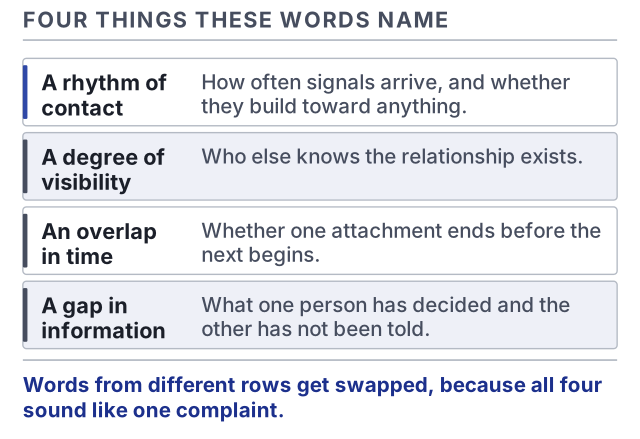
What do these words NOT mean?
They do not name intentions, personality types or conditions. Micro-cheating is a label for small acts read as breaches of an agreement, not a diagnosis of anybody’s character. Its edges shift with whatever agreement is in play.
They are also not confined to dating. Several transfer straight into friendship, family contact and hiring. That transfer is a good test of what a word is really about: if it survives outside romance, it was describing contact, not love.