What does monogamy mean?
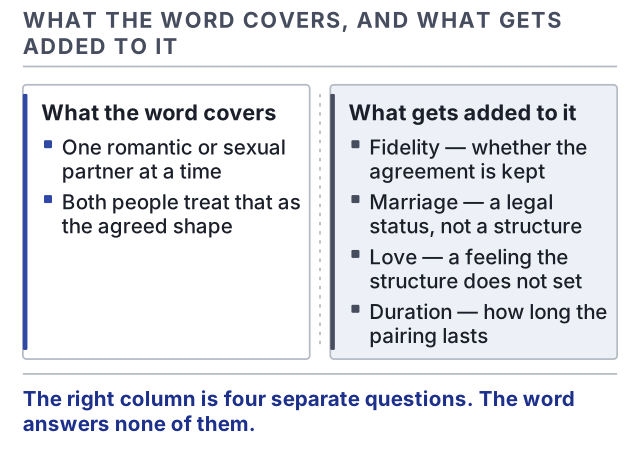
The monogamy meaning is narrow: monogamy means having one romantic or sexual partner at a time. Both people treat that as the agreed shape of the relationship. The word describes structure and nothing else. It names partner count, not marital status, not depth of feeling, not how long the pairing lasts.
It is the reference point for most other terms in this section. Formats such as ethical non-monogamy and polyamory are defined by how they depart from monogamy. That is why the definition has to be narrow to be of use. If the word is stretched to mean “committed” or “serious,” the contrast it exists to draw disappears.
Writing for general readers takes up the experience of the structure rather than its meaning. Mating in Captivity, published by HarperCollins is one such book on desire inside long-term monogamy.
What does monogamy look like in use?
In use, the word is most often a stated preference. It is also a label put on a decision after the fact. Consider three ordinary sentences. They are shown as usage, not as advice:
- A dating profile reads “monogamous, looking for the same.” The writer states a wanted structure up front. It fills the same slot where someone else might write “ENM.”
- Two people dating a few months agree to delete the apps. Later they call that talk “the point we became monogamous.” The word is applied after the fact, to a choice made without a name at the time.
- A friend says “I’m bad at monogamy.” The sentence is a claim about which structure the speaker finds workable. It is not a confession of wrongdoing, though listeners often hear it as one.
A fourth use sits outside dating. In biology, monogamy names a mating system. Researchers split it in two. Social monogamy is a pair that bonds and raises young together. Sexual monogamy is a pair that mates only with each other. Popular articles about “monogamy in animals” almost always mean the first. They are read as if they meant the second.
Where does the word monogamy come from?
The word is built from Greek monos, “single,” and gamos, “marriage.” That is literally “single marriage.” It reached English through Latin and French in the early modern period. Its first English sense was the narrow one: being married to one person. It also named the practice of not remarrying after a spouse’s death.
The looser modern sense is later: one partner at a time, married or not. It widened again as unmarried long-term partnership became ordinary. The biological sense is a separate, later borrowing. Naturalists needed a name for pair-bonded species. The exact decade when speakers dropped the marriage requirement is not established, so this entry does not name one.
What is monogamy confused with?
| Term | What it names | How it differs from monogamy |
|---|---|---|
| Monogamy | One partner at a time, by agreement | — |
| Exclusivity | The agreement to stop seeing other people | A moment or a rule; monogamy is the ongoing structure |
| Serial monogamy | One exclusive relationship after another | Comments on the sequence, not on any single relationship |
| Monogamish | A mostly monogamous couple with narrow agreed exceptions | Not monogamy: the exceptions are part of the agreement |
| Fidelity | Keeping to whatever was agreed | A value; a non-monogamous couple can also have fidelity |
Monogamish is the nearest neighbour. It is a coined word for couples who keep a monogamous default and agree on set exceptions (full entry). It is not a softer word for monogamy. It names a different arrangement. The difference is that the exception exists, not how often it is used.
Exclusivity refers to the agreement to stop seeing other people. It is a moment or a rule. Monogamy is the standing structure that follows it. Serial monogamy refers to one exclusive relationship after another. It comments on the sequence, not on any single relationship.
The other common swap is between monogamy and cheating. Cheating is not a relationship format. It names a breach of an agreement. The broken agreement is often, but not always, a monogamous one. Non-monogamous arrangements have rules too, such as an agreement to name new partners. Those rules can be broken.
The words on the other side of that line have their own books. Thornapple Press’s Polysecure is one such book on attachment inside non-monogamous structures.
What monogamy does not mean
This is the part most listicles skip. It is also the part that carries the most weight.
It does not mean married. Partner count and legal status are separate. See also what “exclusive” means in dating. That is where the mix-up usually starts.
It does not mean permanent. A monogamous relationship that ends was still monogamous. The word makes no promise about length. Reading it as “forever” is what makes “serial monogamy” sound like an insult.
It does not mean sexually active. A couple can be monogamous and celibate. Celibacy is about how often; monogamy is about how many.
It does not mean love. The structure can hold almost any feeling. Arranged, transactional and deeply romantic partnerships can all be monogamous.
It does not mean honest. The agreement can be real, assumed, or ignored. The word describes what was agreed, not whether anyone kept to it.
It does not mean natural or unnatural. Whether monogamy is a human default is argued in several fields. The meaning of the word does not settle that argument. This entry defines usage and takes no side. Folk claims get quoted a lot: the share of species that pair-bond, the share of people who stray. They circulate without stable sourcing and are not repeated here.
Where this page stops
This is a dictionary entry. It explains what the word means and how people use it. It does not advise on whether to be monogamous. It does not cover how to raise the subject with a partner, or how to handle a broken agreement. Those are conversations, not definitions.
Sometimes an arrangement is enforced through pressure, monitoring or threats. That is outside what any glossary can address. A licensed therapist or counsellor, or a helpline, is the right place for it.
The open and non-monogamous section collects the rest of the vocabulary.
Checked: August 26, 2026. Status: current — in continuous general use, not slang, and not showing signs of shifting meaning.