Dating slang is vocabulary that spreads by use rather than by decree: no committee approves it, no publication fixes its edges, and the meaning is whatever a large enough group of speakers agrees it is this year. That is the whole reason a slang section needs dates on every entry.
It also explains the two honest limits of this section. Some words cannot be traced to a coiner, and some are already fading while the trend pieces still call them new.
What makes a word dating slang rather than a dating term?
Its route. A dating term such as “exclusive” comes from ordinary English with a documented history; slang refers to vocabulary that arises inside a group and spreads outward on the strength of use alone, often carrying the tone of the group it came from.
For example, a word can arrive from fandom, cross into general dating talk, and keep an undertone of self-mockery that its new users only half notice. That undertone is part of the definition, and it is the part explainers usually drop.
Why does every slang entry carry a date?
Because slang moves and a dictionary that will not say when it last looked is guessing. A headword marked current this year may be dated the next, and the state stamp under each entry exists so a reader can see the claim being made rather than infer it.
A state stamp is this dictionary’s one-word claim about a headword’s standing: current, rising or dated, printed with the month the entry was last read. Consider the difference between a word people use and a word people explain. Once a term appears mainly in lists of terms, it has stopped being live vocabulary and started being trivia — and the checked date is what lets an entry admit that.
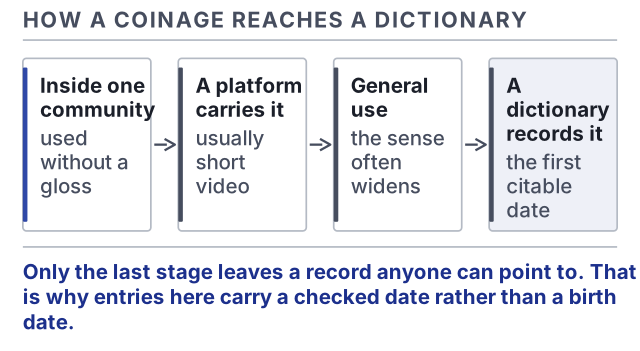
When can a slang word’s origin be traced?
Rarely, and the entries say which. Some words leave a record: a documented first use, a scene that is well covered, an eventual dictionary entry that fixes a date. Thirst trap, for instance, is one of the few here whose lexicalisation is on record, having been added to Merriam-Webster’s dictionary in a published batch of new words.
Most are not like that. Where no primary record exists, the entry says the origin is not established rather than repeating the most confident story in circulation.
What does this section deliberately not do?
It does not tell anyone how to use these words, or judge the people who do. Several of the headwords here are used dismissively; the entry notes that as a fact about usage without joining in.
It also does not treat slang as a lesser vocabulary. These are the words people actually reach for, and the only difference from the rest of the dictionary is how quickly they move.