What does DTR mean?
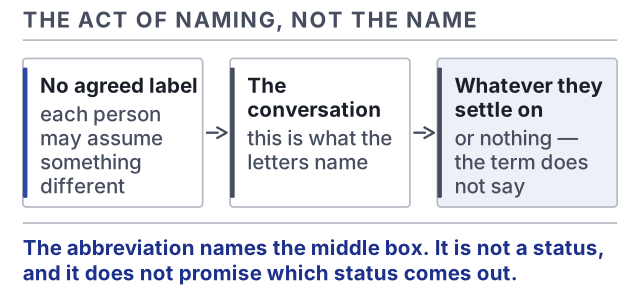
DTR is short for “define the relationship”: the conversation in which two people state what they are to each other and which label, if any, applies. The DTR meaning is narrow — the abbreviation names the act of naming. It does not name the answer, and it does not describe any particular status.
That distinction is the whole entry. A DTR can produce exclusivity, an open arrangement, a friendship, or nothing at all, and the word stays accurate in every case. Not to be confused with the same three letters outside dating. In clinical notes, deep tendon reflex is what they abbreviate. In nutrition they stand for the credential Dietetic Technician, Registered.
In grammar it works three ways. It is a noun (a DTR), a modifier (the DTR talk), and a verb (we still haven’t DTR’d). The verb use is the newest of the three.
What does DTR look like in use?
In use, DTR names a conversation being scheduled, reported, or joked about. Consider four ordinary sentences, offered as illustrations rather than recommendations:
- A text reads “can we DTR this weekend.” The sender is booking a conversation and flagging that it will be about status. Which status they want goes unsaid.
- Someone tells a friend “we had the DTR and it went fine.” The sentence reports that the conversation happened. The listener still does not know the outcome, and asks next.
- A group chat message says “he DTR’d me at a bus stop.” The comedy is in the gap between the weight of the word and the setting. That is an attested register for the term.
- On a dating profile: “not looking for a DTR anytime soon.” Here the word stands in for the whole business of labels. It is shorthand for pace rather than for structure.
Where does DTR come from?
What the reference record carries is a definition rather than a history. Dictionary.com’s entry for DTR records it as chat and texting shorthand for define the relationship — the conversation in which one person wants a clear answer about status — and gives no coiner, no venue and no decade. The phrase was useful because it named something people were already doing without a word for it, and this entry does not supply the origin the record leaves out.
The full phrase circulates in English alongside the three-letter form, which belongs to typed conversation: forums, instant messaging, texting. Abbreviating a stock phrase is ordinary there. Short-video platforms have since carried it back into speech, where people say “dee-tee-arr” aloud.
Who first shortened the phrase, and in which year, is not established. This entry names no coiner and no date, because the lexicographic record read for this page carries neither.
The unrelated senses have their own histories. In clinical notes DTR abbreviates deep tendon reflex, the response elicited by tapping a tendon during a neurological examination — a reference chapter this glossary points at and does not interpret, having no clinical remit. The dietetics credential is an initialism of a job title awarded by the Commission on Dietetic Registration, and the same registration is now also carried as NDTR. Neither borrowed from the dating sense, and the dating sense did not borrow from them.
What is DTR confused with?
DTR is confused most often with the outcomes it can produce: exclusivity, a label, a public announcement. It is rarely confused with other names for a conversation.
| Term | What it names | How it differs from DTR |
|---|---|---|
| DTR | The conversation that settles what two people are | — |
| Exclusive | An agreement to stop seeing other people | A possible outcome of a DTR, not the conversation |
| The talk | Any high-stakes relationship conversation | Broader: can be about moving in, exes, or ending things |
| Hard launch | Publicly naming a partner on social media | An announcement to others; a DTR is between the two people |
| Commitment | The ongoing intention to stay | A stance over time; a DTR is a single event |
The closest neighbour is exclusive. Exclusivity is an agreement to stop seeing other people, and it is one possible outcome of a DTR rather than the conversation itself. People routinely use “we DTR’d” to mean “we agreed to be exclusive,” and in a given case that may be what happened. Still, the words are not the same. A DTR that ends in “let’s keep this casual” is still a DTR.
The second frequent swap is with hard launch. Both make a relationship legible, but the audience differs. A DTR is aimed at the other person. A launch is aimed at everyone else. A couple can, for example, DTR and never post, or post and never have named anything privately.
A third confusion runs toward undefined-status words: the family of terms for relationships that have not been defined. Those words describe a state. DTR describes the conversation that ends, or fails to end, that state. They belong to different word classes, and this entry does not expand them.
What DTR does not mean
The boundary is the most useful part of this entry.
It does not mean exclusivity. The abbreviation is neutral about the result. Reading DTR as “becoming official” is the error this entry exists to correct.
It does not mean a proposal or any formal step. DTR sits earlier and lower than engagement, moving in, or anything legal.
It does not mean the relationship is serious. For instance, people DTR casual arrangements too, and naming something casual is still defining it.
It does not mean a confrontation. The word is neutral in tone; any dread attached to it belongs to the situation, not to the abbreviation.
It does not mean a label was reached. A DTR can end unresolved. The conversation happened; the definition did not arrive. The word still applies.
It does not mean romance at all, outside this context. In a chart note or after a doctor’s name, the letters mean something else. No dating sense should be read into them.
It is not a stage. Status and format words name what a relationship is. DTR names an event that may or may not change that.
Where this page stops
This is a dictionary entry. It records what the abbreviation means, how it is used, and where its edges are. It does not advise on when to have such a conversation, how to open one, what to say, or how to read a partner’s answer. Those are conversations, and they belong to people, not to glossaries.
If a relationship involves pressure, monitoring, or fear about raising a subject at all, that is beyond what a definition can address. A licensed therapist or counsellor, or a helpline, is the appropriate route.
Neighbouring vocabulary is indexed in the A–Z of dating terms.
Checked: August 26, 2026. Status: current — in ordinary use in both typed and spoken English. This entry records no change in its meaning as of the check date.