The words in this section share one history. Each came from a book, a clinic or a research literature, then entered ordinary speech and lost its edges on the way. That drift is normal. It is also why these terms cause more arguments than the app-era slang two sections over.
Limerence refers to an involuntary state of obsessive romantic longing for one person. It was named in a book about that state, not in a diagnostic manual. Enmeshment means a family or relationship pattern in which the boundaries between people are so open that a separate position is hard to hold. The term comes from structural family therapy, not from dating writing.
Why does the origin of the word matter so much here?
Because it explains the argument. When a term is coined inside a field, its first users share assumptions they never have to state. When the word travels, those assumptions stay behind, and the everyday sense broadens.
Take enmeshment. The idea reached a wide professional audience through Salvador Minuchin’s work on family structure, published by Harvard University Press. In that setting it named one end of a range of boundary permeability. In a group chat it usually means “your mother is too involved”. That is a real use, but a much smaller one.
What is the difference between a word and a diagnosis?
A word describes. A diagnosis measures one person against criteria. Nothing in this section does the second thing. Several entries say so outright, where the risk of misreading is highest.
For instance, codependency is a widely used term for a pattern of relating built around another person’s needs. It appears in an enormous amount of popular writing. But it is not a clinical category, and no entry here will tell a reader whether it fits them. Writing on where one person ends and another begins, such as Nedra Glover Tawwab’s Set Boundaries, Find Peace, belongs to a different genre than a glossary.
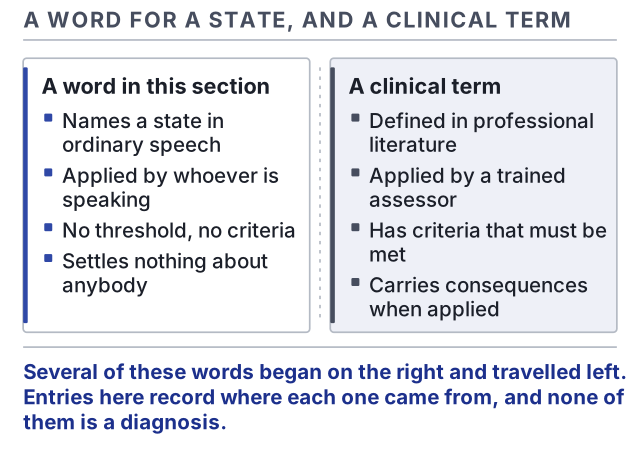
How do these words drift in ordinary use?
They broaden, almost always in the same direction: from a specific state to a general complaint. A term that named something narrow becomes the available word for a whole family of feelings. Then arguments start about whether it “counts”.
Imagine two people using “obsessed” and “limerent” for the same week of thinking about somebody. Neither is wrong about their own experience. They are disagreeing about how much weight the second word carries. That is a question about vocabulary, not about either of them.
What does this section deliberately not do?
It does not offer treatment, steps or verdicts. Where a state has a clinical version, the entry names that and stops.
If a word here describes something that is making life harder, the useful next step is a qualified professional. A dictionary is the wrong tool. Pretending otherwise would be the more harmful choice.