What does courting mean?
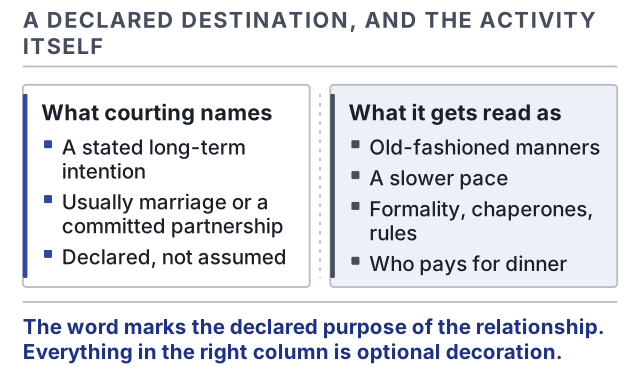
Courting means seeing someone romantically with a stated long-term intention behind it. The intention is usually marriage or a committed partnership. Dating, by contrast, leaves the endpoint open. The courting meaning that dictionaries record is a declared purpose. It is not a description of the relationship’s activities or its pace.
Not to be confused with the other courting in English, such as courting disaster, courting controversy, and courting investors. Those use the same verb in its older sense of seeking something out. They have nothing to do with romance. A court of law is a separate branch of the same word.
What does courting look like in use?
In use, courting is a claim about intention, not a report of behaviour. Consider three ordinary sentences, offered as illustrations rather than instructions:
- Someone tells a friend, “we’re not dating, we’re courting.” The speaker is claiming a declared destination. The claim usually signals a slower or more deliberate pace than the friend assumed.
- A profile line reads “courting, not collecting.” Here the word does contrast work against app-era dating. The writer expects the reader to hear that contrast.
- A wedding speech mentions “a short courtship.” That is the historical, neutral use: the period between meeting and marrying. It makes no claim about how that period was spent.
A fourth use is the passive one: being courted. It turns up in dating talk. It turns up more often in business and sports writing, about a company or a player being pursued. The romantic and the recruitment senses have run in parallel for a long time.
Where does the word courting come from?
The verb traces to the royal court. To pay court to someone was to attend on them and seek their favour. English took the phrase from French usage. The romantic sense grew out of that image of formal attention paid to a person of standing. Courtship is the noun for the period before marriage. Its path from the acts of a courtier to the wooing sense is set out in Etymonline’s entry for courtship.
For centuries courting described the ordinary path to marriage. Family involvement and explicit intentions were often part of it. The word thinned out across the twentieth century as “dating” took over. “Dating” is the newer term, built around the private outing rather than the family-approved suit.
The revival has two clear sources. One is the Christian courtship movement in American evangelical publishing in the 1990s. It promoted courting as a deliberate alternative to dating, with family involvement and marriage as the explicit goal. That sense is still the live one in some religious communities. It carries specific rules the general word does not.
The other source is looser and more recent. Short-video and dating-app speech reached for an old-fashioned word to name intentional dating. This second revival borrowed the tone and dropped the rules. The point at which it became common is not established, so this entry does not name one.
What is courting confused with?
Courting is confused most often with dating, courtship, exclusivity and engagement. Those four words name an activity, a period, a rule and a decision.
| Term | What it names | How it differs from courting |
|---|---|---|
| Courting | Dating with a stated long-term intention | — |
| Dating | Romantic time spent together, endpoint open | Makes no claim about where it is heading |
| Courtship | The period of courting, as a noun | Same idea, usually looking backwards |
| Being exclusive | An agreement not to see other people | A rule about others; courting is a direction |
| Engagement | A formal agreement to marry | The outcome courting may aim at, already decided |
| Wooing | Actively trying to win someone's affection | About persuasion; courting is about intent |
The sharpest confusion is with what “exclusive” means in dating. Exclusivity is a rule about other people. Courting is a statement about direction. Two people can, for instance, be exclusive with no long-term intention discussed. In the loose modern sense they can also be courting without agreeing to stop seeing others.
Dating is the other habitual swap, and it is the younger word. Etymonline’s entry for date records the romantic sense arriving around the turn of the twentieth century. That is long after the court vocabulary it now sits beside.
The second confusion is with monogamy. Courting says nothing about partner count. In its strict religious sense one partner is assumed. In casual use the assumption does not hold.
A third overlap is with DTR, the conversation that assigns a relationship its label. Courting can be the thing named in a DTR. The two words sit at different levels: one is a status, the other is the talk that sets a status.
What courting does not mean
It does not mean engaged. Courting states an intention, while engagement is a decision already made. Treating the two as the same makes “can I court you” sound alarming to people who hear it as a proposal.
It does not mean chaste. The religious courtship movement attached rules about physical contact to the word. Those rules travelled with it inside that community. The general word carries no such content. Using it signals nothing about what a couple does or does not do.
It does not mean gendered. The historical picture is of a man courting a woman, and the older sense assumed that direction. Current usage is symmetrical. Dictionaries and speakers both apply the word in either direction.
It does not mean slow. Deliberate is not the same as unhurried. A courtship can move quickly. The word describes purpose, not tempo.
It does not mean formal or supervised. Family approval, chaperones, and permission belong to particular historical and religious versions of courting. They are not part of the definition.
It does not mean sincere. The word describes a stated intention. Whether that intention is real is a separate question. The vocabulary cannot answer it, and no term in this glossary can verify it.
Where this page stops
This is a dictionary entry. It explains what the word means and how people use it. It does not advise on how to court someone, how to ask for a serious relationship, or how to read another person’s intentions. Those are conversations, and they belong outside a glossary.
Sometimes a person is pressured toward a commitment, monitored, or told that a stated intention obliges them to something. That sits outside what a definition can address. A licensed therapist or counsellor, or a helpline, is the right place for it.
For the rest of the vocabulary of stages and labels, the status and formats section collects the neighbouring entries.
Checked: August 26, 2026. Status: current — an old word in active revived use, with two live senses (religious and general) that do not carry the same rules.