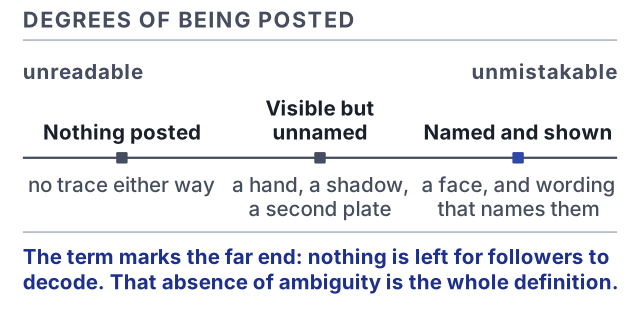
Hard launch means the public, plain announcement of a relationship on social media. It is a post that shows a partner’s face and frames them as a partner. A caption, a tag or the setting leaves nothing for followers to decode. The hard launch meaning is about visibility, not about how serious the relationship behind the post is.
Not to be confused with the older business sense of the phrase. There a hard launch is a full public release of a product after a limited one. The dating sense borrowed the shape of that image and kept the word launch. That is why the vocabulary sounds like marketing.
What does a hard launch look like?
A hard launch looks like a post that identifies a partner rather than hinting at one. Consider four scenes, offered as illustrations of how the phrase is used rather than as suggestions about posting.
- A grid post of two people at a wedding, both faces visible, the partner tagged by handle. Nobody in the comments has to ask who that is.
- A birthday story that names a partner and shows them clearly. For months the same account had shown only a shoulder or a shadow.
- A video with “hard launch” in the caption itself. The label does the announcing, and the footage is the evidence. This self-labelling use is common, so the term often appears in the post it describes.
- A profile-picture change to a photo of two people, which is read as a launch even without any caption at all.
The shared feature is identifiability. A viewer who does not know the couple can tell that a relationship exists. That viewer can also tell who the other person is.
Where does the term hard launch come from?
The phrase is borrowed from product and software release talk. There a hard launch is a full public release, set against a limited or quiet one. That contrast pair moved into dating talk whole. That is why the two dating terms arrived together rather than one at a time.
Its route into dating vocabulary runs through image-first platforms. Instagram came first, then short video, where the reveal is itself the content. The move is usually dated to around the turn of the 2020s.
Beyond that, the origin is not established. No first post, account or publication can be credited with the dating sense, and this entry does not invent one. What can be said is that the word arrived as a loan from marketing. It was not coined inside dating communities.
What is a hard launch confused with?
A hard launch is confused most often with terms of agreement like DTR and exclusive. It is also confused with terms of concealment. None of those describe what a feed shows.
| Term | How it differs from hard launch |
|---|---|
| Soft launch | The paired term for a partial, non-identifying reveal. Defined here only for contrast; it is a neighbouring term with its own coverage elsewhere and is not expanded on this page. |
| Instagram official / IG official | Near-synonym, older and platform-bound. Hard launch is platform-neutral and emphasises the manner of the reveal rather than the venue. |
| DTR | A private conversation defining a relationship's status. A hard launch is public and unilateral in form; the two can happen in either order, or one without the other. |
| Exclusive | An agreement between two people about seeing other people. Hard launch says nothing about that agreement — it describes what was posted, not what was agreed. |
| Stashing | Describes keeping a partner hidden from a social circle over time. It is not the technical opposite of hard launch: not posting is not the same as concealing. |
The mix-up worth naming is with terms of agreement rather than terms of visibility. A hard launch is a fact about a feed. Whether a couple have named their status to each other is a separate question. Other words handle it: see DTR and exclusive.
Soft launch is the paired term for a partial reveal that names nobody. It is defined here only for contrast. Instagram official is the older near-synonym, tied to one platform. It names the same reveal by its venue rather than by its manner.
A second mix-up is with concealment. Because a hard launch is loud, its absence is sometimes read as hiding. The words for that are different again. Stashing refers to keeping a partner hidden from a social circle over time — see stashing. It describes an active pattern rather than an unposted phone.
What does hard launch not mean?
Hard launch does not mean commitment, sequence, novelty, agreement or honesty; it reports visibility and nothing else. This is the useful edge of the term.
It does not mean commitment. The word describes a post. It carries no information about exclusivity, length, plans, or how either person would describe the relationship offline.
It does not mean a soft launch happened first. The two words form a pair in commentary, not a required sequence. Many relationships are announced with no earlier hinting, and most are never posted at all.
It does not mean the relationship is new. For example, long relationships get hard-launched late. The reason may be years of private accounts, job constraints, or simple disinterest in posting. The launch dates the post, not the pairing.
It does not mean both people agreed to it. In ordinary usage the term describes what one account published. Whether the other person expected it is outside what the word reports.
It is not a measure of honesty. A quiet feed is not evidence of anything, and a loud one is not proof of anything. The term is descriptive of visibility only, and reading character off it is a use the definition does not support.
It is not an event with rules. There is no threshold of likes, no required caption, no correct order of platforms. If a post identifies a partner, the word applies.
Is hard launch a current term?
Yes, and it is still spreading rather than fading. It is one of the few dating terms that people apply to themselves as they use it, for instance by writing the label into the caption. That keeps the word visible, and it teaches new users what it means.
It also retains its business sense in parallel, without much interference: a company hard-launches a product, a person hard-launches a partner, and context separates the two cleanly. Terms in the Status and formats hub tend to work this way: borrowed frames applied to relationship stages.
Where this page stops
This entry defines a phrase. It is not advice about whether, when or how to post about a relationship. It takes no position on what a person’s posting choices say about them.
Sometimes the question behind this page is heavier than vocabulary. There may be pressure to post, pressure not to, or a situation that cannot be raised safely with a partner. A qualified professional or a helpline is the right next step, not a longer glossary entry.
Checked: 2026-08-26. Entries in this hub are reviewed on a fixed cycle; the date above is the last review of this one. More status words: Status and formats.