What does asexual mean?
Asexual is a self-chosen label, used by people who feel little or no sexual attraction to others. It says how someone reads their own attraction. It is not a diagnosis. It is not a report of what they do. It is not a promise about what they will do. The short form is ace.
Not to be confused with the biology sense. Asexual reproduction means young made without a second parent. That is an older, separate use of the same word, and the bare term is still read that way. Everything below is about the identity word only.
Two things matter for reading the identity sense. It is said in the first person. It is also graded. Asexuality spectrum (or ace spectrum) is the standard phrase. People place themselves near the word rather than exactly on it.
What does the word asexual look like in use?
The term turns up where attraction is being named, not where acts are being reported. Here are a few scenes.
A dating profile reads “ace, open to a romantic relationship.” The line splits two things English tends to bundle: sexual attraction and romantic interest. The writer is filtering for readers who know the difference.
Someone says “I’m on the ace spectrum” instead of “I’m asexual.” The hedge does real work. It marks a place near the word without claiming the flat form. That is what the spectrum phrase is for.
In a group chat, someone answers a question about a crush with “asexual, not aromantic.” The pairing corrects a guess. That it needs saying at all is why the two words exist apart.
A commenter writes “ace people can still date,” in reply to a stranger who thought otherwise. That is not a definition. It is the same misreading, pushed back on in public, again and again.
Where does the word asexual come from?
The identity sense was built online, in English, early this century. The spelling is much older. By the Online Etymology Dictionary’s record, asexual has been in English since the nineteenth century as a term from biology. A sense applied to people is attested later in the same century. It joins the Greek prefix a- (“without”) to sexual. In biology it means young made without a second parent. That record covers how the word entered English. It says nothing about the century that followed.
The identity sense is a modern reuse, and the meaning in force today came out of that online period. The group usually credited with settling it and spreading it is the Asexual Visibility and Education Network (AVEN), founded in the early 2000s by David Jay. One caution about wording. AVEN’s own overview says an asexual person does not feel sexual attraction. The shorter formula “little or no sexual attraction” is what now runs through dictionary entries, news explainers and profile bios. This entry does not put it in AVEN’s mouth.
The nearby words were built in the same period and the same places. The split of romantic from sexual attraction, the spectrum terms, and short forms such as ace and aro all came out of community talk. None of it came from academic or clinical naming. This entry names no coiner for any of them.
What is on the asexuality spectrum?
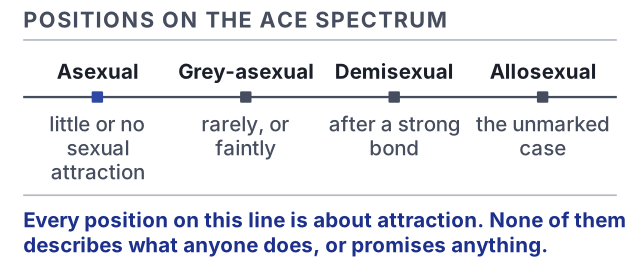
Ace spectrum is an umbrella for labels that sit near asexual rather than on one fixed point. The common ones:
Greysexual is the term for people who feel sexual attraction rarely, weakly, or only in ways they find hard to sum up. Grey-ace and graysexual are the same word.
Demisexual is sexual attraction that arrives only after a close bond has formed. It has its own entry here.
Narrower terms such as aegosexual also circulate in community use. The list is not closed, and no body keeps it.
Beside these sits the split attraction set of words. It pairs a sexual term with a romantic one: biromantic asexual, heteroromantic asexual, aroace. That is why ace-spectrum words say so little about the shape of anyone’s love life.
This dictionary does not rank these terms by how real or how settled they are. Its job is to record that people use a word, and what they use it for.
What is asexual confused with?
Most often with aromantic, with celibacy, with low sex drive, and with the biology sense of the same spelling. The table sets out what each word points at.
| Term | What the word points at | Key difference from asexual |
|---|---|---|
| Asexual | Self-identification: little or no sexual attraction to others | — |
| Aromantic | Little or no romantic attraction | Different axis; the two words are independent of each other |
| Demisexual | Attraction that follows a close emotional bond | Sits on the ace spectrum; conditional rather than absent attraction |
| Celibate / abstinent | A choice not to have sex | Describes behaviour and intent, not attraction |
| Low libido | Level of sexual desire, often discussed medically | A description of drive; asexual is an identity term, not a measurement |
| Asexual reproduction | Biology: offspring produced without a second organism | Unrelated older sense of the same spelling |
Asexual and celibate get run together, because English speakers hear both as “not having sex.” One is about attraction. The other is about conduct. Either can hold without the other.
The line with clinical language is where use is truly contested. Low sexual desire has clinical names. Ace groups have long argued that an identity is not a symptom. Some clinicians and writers draw the line elsewhere. This entry names the split and leaves it there. Settling it is not a dictionary’s job. The nearby identity and orientation hub collects the words around it.
What asexual does not mean
It does not mean a lack of something. Framing the word as an absence is a choice of frame, not a meaning. People who use it name something they have, in the same grammar as any other label.
It does not mean celibacy. The word makes no claim about what anyone does. It neither implies nor rules out any act.
It does not mean aromantic. Romantic attraction is a separate axis with its own words. The two can pair up in any way.
It does not mean a disorder. Asexual is a self-chosen label, not a clinical class. This entry sizes up nobody.
It does not mean “hasn’t met the right person yet.” That is a reply the word draws. It is not part of what the word says.
It does not mean the same thing as being single. Status and orientation are separate things. The word says nothing about being single or partnered.
It does not call for proof. Nothing in its use implies a bar to clear, a test, or a lasting tie to the label.
It does not mean asexual reproduction. The biology sense shares the spelling and nothing else. The same split shows up in the entries on limerence and infatuation. There, too, a plain word and a technical one share ground.
Where this page stops
This is a dictionary entry. It defines a word. It does not size up anyone’s orientation, name the label that fits a reader, or say how a bond should work.
Some searches carry more than a word question. They carry distress about who one is, pressure from a partner or family, or a change in desire that worries. That belongs with a licensed therapist, a doctor, or a helpline, not with a glossary.
Checked: 26 August 2026. State: current — the core sense is stable, while the spectrum words around it keep growing, and this entry is re-read as they do.