What does platonic mean?
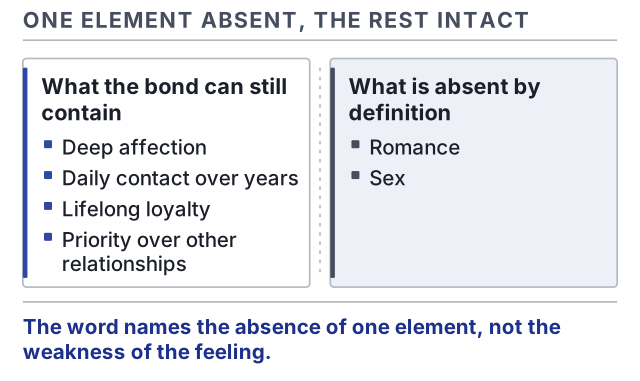
Platonic means a bond that is close, sometimes intense, and not sexual or romantic. That is the platonic meaning in current English. The word marks what a relationship leaves out rather than what it holds. That is why a platonic tie can be the closest one in someone’s life and still take this name. The lowercase adjective reaches English from Plato by way of the Renaissance. That history is set out in Etymonline’s entry for platonic.
Not to be confused with the capitalised uses. Platonic in philosophy refers to Plato’s theory of forms, and Platonic solids are a class of regular polyhedra in geometry. Those senses share an origin with the dating word and nothing else. This entry covers the lowercase one.
What does platonic look like in use?
The word appears where a relationship needs a label that rules romance out without ruling closeness out. Consider four scenes that carry most of the usage.
A dating profile carries the line looking for something platonic. The person is after friendship or company, and is flagging in advance that a date is not the goal.
Two people who have known each other for years are asked, again and again, whether anything ever happened. They answer it’s platonic — a category, not a denial of affection.
Two friends buy a flat together, name each other in emergency paperwork and raise a child between them. Onlookers reach for romantic words because the arrangement is domestic. The people inside it use platonic because the shape of the household says nothing about romance.
Someone reports that a friendship stopped feeling platonic. Here the word marks a boundary being crossed rather than a state. That use works only because the term is defined by exclusion in the first place.
Where does the word platonic come from?
From the name of the Greek philosopher Plato, but not from anything Plato wrote. In the Symposium, love is described as a ladder. It climbs from one beautiful body to bodies in general, then to minds, laws and at last beauty itself. The word for that ascent was not platonic love.
The phrase was made in the Renaissance. Latin-writing Italian humanists used amor platonicus for love aimed at a person’s soul rather than their body. The commentary tradition around Marsilio Ficino’s reading of the Symposium is the usual reference point. That account is set out in Wikipedia’s article on Platonic love.
English borrowed the phrase in the seventeenth century, by Etymonline’s record, and it briefly became court fashion. A stage comedy of the period, The Platonick Lovers, is the standard example given when that fashion is described. From there the meaning flattened. Modern speakers keep the exclusion: no sex, no romance. They have dropped the ladder to the eternal forms.
That flattening is the whole story of the word. What began as a claim about what love is for now works as a plain status label.
Platonic vs romantic and other look-alike terms
The comparison table sets out which nearby word does what.
| Term | What the word points at | Key difference from platonic |
|---|---|---|
| Platonic | A close bond framed as non-sexual and non-romantic | — |
| Romantic | A bond framed by courtship, exclusivity or desire | Names what platonic explicitly excludes |
| Friendship | A specific relationship type | Platonic is the wider label; it also covers non-friend bonds framed without romance |
| Just friends | A defensive status report about one pair | Carries a denial; platonic is neutral and categorical |
| Queerplatonic | A committed bond that community usage places outside both friendship and romance | Coined to name what platonic could not; not a synonym |
| Asexual | A self-description about sexual attraction | Describes a person, not a relationship; asexual people have romantic relationships |
| Celibate | A choice to abstain from sex | Says nothing about romance; a couple can be romantic and celibate |
Just friends and platonic are treated as interchangeable and are not: one answers an accusation, the other names a category. Just friends is a defensive status report about one pair, while platonic is neutral and categorical. Queerplatonic refers to a committed bond that community usage places outside both friendship and romance. It exists because speakers wanted a word for committed non-romantic partnership and found platonic too weak to carry it. That is evidence in itself that the older word had drifted towards meaning merely friendly.
What is platonic confused with?
Platonic is confused most often with words about people rather than about relationships: celibate, asexual, aromantic, and the compound platonic soulmate.
Celibate and asexual. Both are about sex, which makes the swap tempting, but they are different objects. Celibate refers to a choice to abstain from sex. Asexual is how people who describe themselves that way name a pattern of attraction. Platonic describes a relationship between two people. See the asexual entry for that word on its own terms.
Aromantic. A word people use of themselves when romantic attraction is not part of their experience. The aromantic entry covers it. A platonic relationship is a relationship. Aromantic is a word about a person. Neither implies the other, and someone can have platonic relationships without being aromantic.
Platonic soulmate. A common compound that pulls the word into the language of fate, such as destiny and being meant to meet. That is a different word family with its own books. This entry stops at the adjective and does not expand the compound.
What platonic does not mean
It does not mean second-best. Nothing in the definition ranks the bond below a romantic one. The word describes what a bond is made of, not how much it matters.
It does not mean nobody is attracted. Platonic describes how a relationship is framed and conducted. For example, one-sided attraction can exist inside a relationship both people still correctly call platonic.
It does not mean no physical contact. Contact that the people involved read as non-sexual is common in platonic bonds across cultures. The word does not bar it.
It does not mean temporary or pre-romantic. Popular usage sometimes treats platonic as a waiting room before romance. That is a story about certain bonds, not part of the term’s meaning.
It does not mean Plato’s idea of love. In the old sense, desire climbed from a body towards the forms. English left that behind when it took the phrase in.
It does not mean an agreement is in place. Two people can use the word about the same bond for different reasons and with different hopes. The label reports a frame. It does not certify that both people share it. Where a stated arrangement is at stake, the words shift to terms like exclusive.
Where this page stops
This is a dictionary entry. It defines a word, sets out where the word came from and marks where it stops. It does not judge anyone’s relationship. It does not say whether a given bond is platonic, or advise on what to do next.
Sometimes the search behind this page is heavier than vocabulary. A friendship may have become distressing, pressure may be applied about sex or exclusivity, or someone may feel unsafe. That belongs with a licensed professional or a helpline, not with a glossary.
For nearby words about relationship formats, see the status and formats hub. The full A–Z index of dating terms is there if you arrived with a different word in mind.
Checked: 26 August 2026. State: current — platonic is long-established English, stable in its core sense, and re-read here as the surrounding vocabulary for non-romantic commitment keeps growing.