What does body count mean?
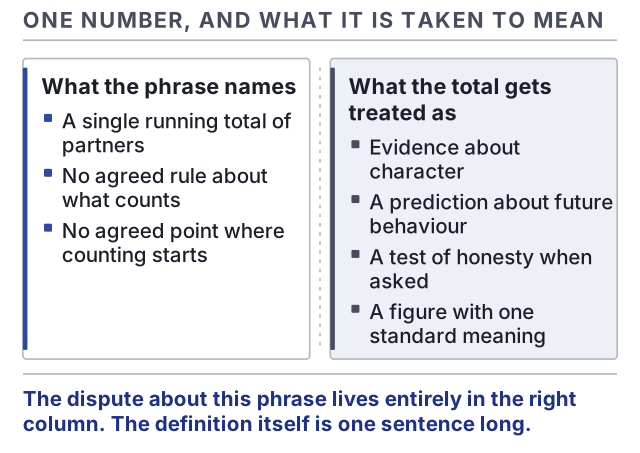
Body count means the number of people someone has had sex with, stated as a single running total for their life so far. In dating slang the body count meaning stops there: the phrase names a count and nothing else — not a timeframe, not a relationship status, not a health fact.
Not to be confused with the older and still-current senses of the same words. In news writing, a body count is the number of people killed in a conflict or disaster. In video games and gaming talk, it is the number of opponents a player has taken down. All three senses remain in ordinary use, which is why this entry separates them first.
What does body count look like in use?
In use the phrase turns up as a debate prompt, as a defensive aside, and as the name of the argument itself. Consider a few ordinary uses, as illustrations rather than instructions:
- A short-video caption asks, “what’s an acceptable body count?” The clip is a prompt format — the point is the argument in the comments, not an answer.
- Two friends compare notes and one says, “my body count is lower than people assume.” Here the word is doing defensive work against a guess someone else made.
- A podcast segment is titled “body count discourse.” The phrase has become the name of the argument itself, not just the tally.
One more use is the unmarked one: someone types the phrase into a search bar and means the war-reporting sense entirely. The overlap is real, and it is why this entry opens by separating the three.
Where does the phrase body count come from?
The phrase comes from military and journalistic English, where body count refers to a tally of the dead; the sexual sense is a later borrowing of that image. By the lexicographic record — Dictionary.com dates the military sense to the 1960s — the phrase begins as war-reporting language for tallies of the dead, which makes it the older of the two senses by a wide margin. The same two words are also used in gaming speech as a near-synonym for kill count.
The sexual sense is a metaphorical borrowing from that scorekeeping frame — bodies as units to be counted. Origin not established: Wiktionary carries the sexual sense with no coinage and no venue attached, and the slang references read for this page supply neither, so this entry records no coiner and no origin rather than choosing one. Where the phrase is loud now is easier to see than where it began: English-language internet speech, including formats built around asking the question on camera.
That stage matters for reading the word. Where the question is asked on camera, the answer is addressed to an audience as well as to a partner, and this entry reads that use as performance rather than as disclosure.
Why is body count a controversial phrase?
Because the disagreement is about the metaphor, not the arithmetic. This entry names the positions and settles none of them.
The objection to the framing. Critics argue the phrase imports a scorekeeping, conquest-shaped image into a description of other people, and that “bodies” reduces partners to units. On this reading the neutral phrasing — number of sexual partners — is not a synonym but a correction.
The objection to uneven application. A second, separate complaint is that the same number is read differently depending on the gender of the person reporting it. The usual name for it is a double standard. Note that it is a claim about how the word is used socially, not about what the word denotes.
The defence of casual use. Many speakers use the phrase without any of that weight attached, treating it as slang shorthand or a joke format, and consider the objections an over-reading of a throwaway word.
The counting problem. Underneath all of it sits a definitional gap: the slang never established what counts. Intercourse only, any sexual contact, partners versus encounters — speakers use different rules and rarely state which. Two identical numbers can describe different histories.
None of these positions is adjudicated here. A glossary can report that a word is contested and describe the shape of the dispute; deciding it is somebody else’s page.
What is body count confused with?
Body count is confused with roster or rotation, with the clinical phrase number of sexual partners, with sexual history, and with the unrelated news and gaming senses of the same two words.
| Term | What it names | How it differs from body count |
|---|---|---|
| Body count (dating) | Number of sexual partners so far | — |
| Body count (news, gaming) | Number killed, or opponents defeated | Same words, unrelated sense |
| Number of sexual partners | The same count, clinical register | Neutral phrasing; no scorekeeping metaphor |
| Roster or rotation | People someone is currently seeing | Present tense; body count is cumulative |
| Sexual history | The whole record, including context | Broader; a count is one line of it |
| Sneaky link | A casual, kept-quiet hookup | Names one arrangement, not a total |
Roster and rotation are the sharpest confusion: they name who someone is seeing now. Body count looks backwards across a whole life and says nothing about the present. Someone with a high total may be exclusive with one person today, and the two words do not contradict each other.
Sexual history refers to the whole record a clinician collects — timeframes, protection, testing — and is the second overlap. The slang collects a single figure and drops all of it.
A third is with identity vocabulary, such as asexual. A low or zero total is not the same thing as being asexual, which describes attraction rather than behaviour, and the two are mixed up in casual talk.
What body count does not mean
It does not mean a health status. The phrase carries no information about testing, protection, or risk. Those are clinical questions with clinical answers, and a number by itself supplies none of them.
It does not mean experience. A total counts partners, not skill, comfort, or knowledge. The inference from one to the other is common in the discourse and is not part of the definition.
It does not mean character. The word describes a count. Any moral reading attached to a particular figure comes from the speaker’s values, not from the vocabulary, and this glossary does not supply one in either direction.
It does not have a scale. There is no defined threshold for high or low. Numbers traded online as cutoffs are folklore — repeated because they are repeatable, not because anything establishes them.
It does not mean recent. The count is cumulative and has no window attached. “Last year” or “since we met” are different questions entirely.
It does not mean cheating. A body count that includes people met during a relationship describes that; the phrase on its own makes no claim about agreements kept or broken. Whether an arrangement was agreed belongs to monogamy and its alternatives, not to a tally.
It is not a stable measure. Because no counting rule is agreed, the same person can give two different answers honestly depending on which acts they include.
Where this page stops
This is a dictionary entry. It explains what the phrase means, where it came from, and why people argue about it. It does not advise on whether to ask the question, whether to answer it, what number to give, or how to read someone else’s answer. Those are conversations between people, and a glossary is the wrong instrument for them.
If someone is being pressured to disclose a sexual history, shamed for one, or threatened over it, that sits well outside what a definition can address. A licensed therapist or counsellor, or a helpline in your country, is the right place to take it.
For the rest of the current dating vocabulary, the slang section collects the neighbouring entries.
Checked: August 26, 2026. Status: current — in use in English-language internet speech, contested, and still sharing its spelling with two other senses.