Delulu is internet slang for holding a romantic belief that reality does not support: a crush read as mutual, a two-word reply read as a promise, a stranger read as a future partner. It is a clipped, doubled form of delusional, and the tone is light.
The delulu meaning that matters here is the one used about dating. It is narrower than the tone suggests. The word marks a gap between hope and evidence, nothing more. It is not a clinical term, not a diagnosis, and not a description of anybody’s mental health. The adult word underneath it can be all three.
This is a dictionary entry: meaning, origin, confusions, and the edge of the word. It does not assess anyone and offers no steps.
What does delulu mean?
Delulu means believing something about a romantic situation that the facts do not carry, and naming that belief openly. Two elements sit inside it. First, a belief about a person, characteristically about how much they like the speaker. Second, a shortfall of evidence the speaker is at least partly aware of.
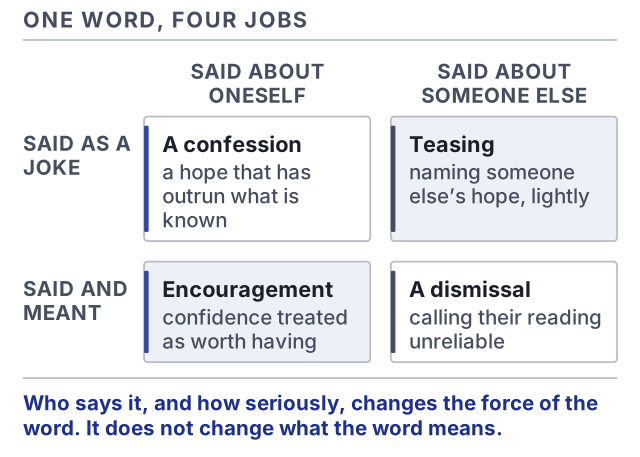
That awareness is what separates the slang from the ordinary adjective. For example, someone who says I am being so delulu about this is reporting on their own hopes from a small distance. The word is a confession dressed as a joke. That is why it spread so easily.
Grammatically it behaves like an adjective: delulu about him, going full delulu. It also appears as a bare noun in the fixed phrase delulu is the solulu. Slang that grows fixed phrases has usually settled into use.
What does delulu look like in use?
In use the word attaches to a hope said out loud past the evidence. It works as a confession, as fandom talk, as a dismissal, or as encouragement. Consider four scenes where the label gets applied. These are illustrations of vocabulary, not signs to measure anyone against.
- The single reply, read closely. A message arrives after two days and says haha yeah. The recipient reads it aloud to a friend and builds a theory on it. She then gets in first by calling herself delulu.
- The fandom sense, still alive. In K-pop spaces the word keeps its first job. It describes fans who talk about an idol as though a personal relationship existed. That use did not disappear when dating talk borrowed the word.
- The comment-section verdict. Under a video about a stalled talking phase, strangers write delulu about someone they have never met. Here the word is a dismissal, not a confession. The two uses share nothing but spelling.
- The encouraging use. A friend hesitating to send a first message is told to be a little delulu. In this frame the word means unearned confidence treated as a resource.
Where does the word “delulu” come from?
The word comes from delusional, and reached dating talk by way of English-language K-pop fan communities. The slang form clips the adjective and doubles the final syllable. English uses that pattern to make a word sound childish and so harmless. It is the same move that turns presentation into presso or chocolate into choccy.
The dating sense arrived by way of fandom. Dictionary.com’s slang entry records the word emerging in the English-language K-pop fan community during the 2010s, used there for fans who spoke about an idol as though a mutual relationship existed, and spreading to general online and dating use in the early 2020s. That record names a community and no person, so no individual coiner is established — and this glossary names none.
The route out of fandom is easier to describe than to date. Short-form video carried the word into general dating vocabulary in the 2020s, largely through the rhyming phrase delulu is the solulu — folklore about self-belief, not a claim this entry can check. What is dated is the lexicographic arrival: Cambridge University Press & Assessment announced the word’s addition to the Cambridge Dictionary in 2025, alongside skibidi and tradwife. The rest of the sequence is repeated widely rather than documented closely, which is the reason this entry carries a checked date.
What is delulu confused with?
Delulu is confused with delusional, with delusionship, with manifesting, with parasocial, and with the older hopeless romantic.
| Term | What it names | How it differs from delulu |
|---|---|---|
| Delulu | A romantic belief held past the evidence, named lightly and usually about oneself | — |
| Delusional | The plain adjective, and in psychiatry a fixed false belief resisting evidence | Carries clinical weight; delulu is the joke form and claims nothing about anyone's mind |
| Delusionship | A separate coinage for a relationship that exists mainly in one person's reading of it | Names a supposed relationship; delulu names a state of belief. Different words, similar root |
| Manifesting | Deliberately holding a belief as a method for producing an outcome | A practice with intent; delulu has no method and often admits the gap |
| Parasocial | A one-directional bond with a public figure who does not know the person exists | A described relationship type; delulu is a tone a speaker takes about their own hopes |
| Hopeless romantic | A self-description about valuing romance highly | About taste and temperament; delulu is about a specific belief exceeding a specific situation |
Delusional is the closest and the weightiest swap. The long word has a psychiatric use. The short one is built to shed it. Calling a belief delulu is not a statement about anyone’s health. This glossary treats any reading in that direction as a misreading of the register.
Delusionship shares the root and is a different word. It names a supposed relationship rather than a frame of mind. Advice writing about that term belongs elsewhere. Here the only job is keeping the two apart.
Parasocial is the nearest technical relative. The fandom origin of delulu is where the two meet. See parasocial relationship for the bond it describes. Delulu stays a tone rather than a relationship type.
What does delulu NOT mean?
Delulu does not mean a diagnosis, a lie, a relationship status, or a belief proven wrong. The boundary of the term:
- It is not a diagnosis, and not a description of anyone’s mental health. The underlying adjective has a clinical use. The slang exists to avoid it. Nothing in this entry should be read as assessing a person.
- It does not mean lying. A lie is aimed outward at someone else. Delulu describes a belief the speaker actually holds, and often announces.
- It is not a relationship status. Delulu says nothing about whether two people are seeing each other, exclusive, or acquainted at all.
- It is not automatically an insult. The self-applied use is affectionate and self-aware, and the dismissive use exists alongside it. The dismissive use exists, but it is one register out of several.
- It does not mean the belief is wrong. The word marks a shortfall of evidence, not a proven error. Hopes labelled delulu sometimes turn out to be right.
- It does not describe one gender. Usage skews toward young women online. The definition does not follow usage.
- It is not the same as the ick or any other reaction word. Delulu is about belief running ahead. The ick is about attraction collapsing.
Where this page stops
This entry defines a word. It cannot say whether the label fits any particular crush. It carries no advice about what to believe, send or stop hoping for. Those are questions about specific people, and a glossary knows nothing about them.
One boundary is worth stating plainly, because this word sits next to a clinical one. Nothing here describes, identifies or assesses a mental health condition. A slang term is never evidence about anyone’s mind. Sometimes the reason for looking the phrase up is heavier than curiosity: beliefs that feel unshakeable and distressing, one’s own or a person’s nearby. A licensed professional or a helpline is the right place to take that. A vocabulary page is the wrong instrument, and pretending otherwise would help no one.
Related entries
Delulu sits in the slang hub, alongside entries such as the ick and thirst trap. That hub carries the intake lane for fresh coinages and dates every one of them. Every term this dictionary covers, including short definition-only lines, is listed in the A–Z index.
Entry checked: 26 August 2026. Usage: rising — moving from fandom into general dating talk, with the fandom sense still active.