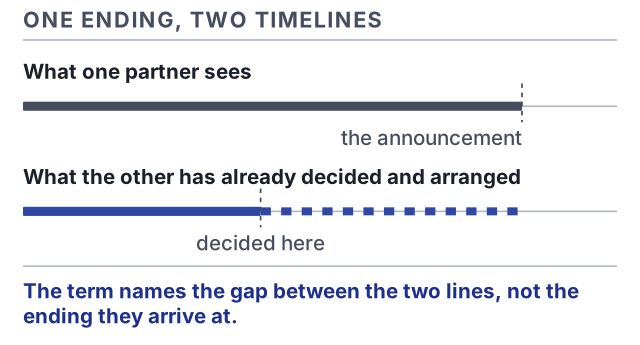
Banksying is dating slang for a breakup that one partner has already decided on and quietly prepared for, while the other still believes the relationship is fine. The ending arrives finished rather than discussed.
Not to be confused with the better-known sense of the name: the street artist Banksy, stencil work, and the auction stunt in which a framed picture partly shredded itself moments after it sold. Trend coverage reads the dating word off that stunt, or off the artist’s unannounced appearances; this entry records both readings and settles neither. It has nothing to do with making art, and the artist is not connected to the coinage.
This is a dictionary entry: meaning, origin, neighbouring terms, and the edge of the word. It contains no steps and makes no judgement about anyone’s relationship.
What does banksying mean?
Banksying means concealing a decision to leave while the relationship continues to look ordinary, then delivering the ending as a completed fact. Several elements sit inside the definition, and all of them have to be present.
A decision already made. The word does not describe doubt or drift. It describes someone who has settled the question internally.
Preparation kept private. Practical arrangements, mental withdrawal, or both, carried out without the other person’s knowledge.
A surface that stays intact. The relationship goes on looking normal. In the version of the word that circulates most, it looks unusually pleasant: plans still made, affection still offered. That contrast is what the borrowed name is usually taken to point at.
Remove any element and a different word applies. For example, a hard conversation nobody saw coming is not banksying if no preparation came first. A visibly cooling relationship is not banksying either, because nothing was concealed.
What does banksying look like in use?
In use, the label lands on a stretch of a relationship that looked ordinary right up to the announcement. Consider four scenes that show where it gets applied. These are illustrations of vocabulary, not signs to measure a partner against.
- The holiday that was already the last one. A trip is taken, photographed and enjoyed. The ending comes shortly after. The word is applied in hindsight, once the sequence looks planned rather than sudden.
- The finished logistics. A breakup conversation opens with arrangements already settled: where someone is moving, when, what happens to shared things. Speakers reach for the term because the plan came before the conversation.
- The retrospective read. Someone describes months of small absences that only made sense afterwards. This is the loosest use of the phrase, and the furthest from a definition. It rests entirely on reading events after the fact.
- The literal one. Outside dating talk, banksying occasionally appears as a verb about producing art in the artist’s manner. The two senses rarely meet in conversation. The collision happens in search results.
Where does the word “banksying” come from?
The word borrows the street artist’s name, and the image usually reached for is the shredding stunt: at a Sotheby’s evening auction, the framed Girl with Balloon passed partly through a shredder concealed in its own frame seconds after the hammer fell, and the result was authenticated under a new title, Love is in the Bin. Sotheby’s own account is the record for the stunt; that the dating word was built on it, rather than on the artist’s habit of appearing unannounced, is an inference the trend coverage splits over, and this entry does not settle it. Applied to a relationship, the term describes an exit installed in advance and revealed at full value.
This entry records no coiner. Attributions circulating in trend coverage have not been verified here, and no dictionary or first-attestation record covers the word yet. What can be dated is the attestation: the dating sense is carried in mainstream dating-trend coverage — Vice, Out and The Tab among others — by the mid-2020s. There is no dictionary record of the word at all, so that coverage is the whole of its documented history, and it fixes neither where the word surfaced first nor how far it travelled.
Two things follow. The word is young enough that its edges are still moving. For instance, some writing uses it for any breakup that felt one-sided, which is broader than the definition above. And any impression of how common the dating sense is should be treated as impression, not measurement. This entry carries no figures, because none have been verified for it.
What is banksying confused with?
Banksying is confused above all with the slow fade, and also with quiet quitting a relationship, ghosting, breadcrumbing and stashing.
| Term | What it names | How it differs from banksying |
|---|---|---|
| Banksying | A decided, privately prepared exit behind a relationship that still looks normal | — |
| Slow fade | Contact and effort thinning out gradually, with no ending stated | Visible as it happens; banksying hides behind an intact surface |
| Quiet quitting a relationship | Staying present while withdrawing effort, with no exit planned | No exit is prepared; banksying requires one |
| Breadcrumbing | Occasional attention that keeps a connection alive without advancing it | Aims to continue contact; banksying aims to end it |
| Stashing | Keeping a partner out of one's public and personal life | About concealed visibility, not a concealed ending |
Slow fade is the closest neighbour. Both describe an ending that the other person did not agree to. The slow fade is visible while it happens and usually never gets announced. Banksying keeps the relationship looking well and finishes it in one move.
Ghosting is disappearance in place of an ending, and belongs here only as a contrast. Banksying includes the ending. That is why the two are not variants of each other.
Breadcrumbing is occasional attention that keeps a connection alive without advancing it. It points the other way: keeping a thread rather than cutting one. See breadcrumbing for that term in full. Stashing shares the theme of concealment but hides a person rather than a decision. The entry for stashing covers the difference. A sudden turn-off is a different thing again, and belongs to the ick.
What does banksying NOT mean?
Banksying does not mean every surprising breakup, cheating, a slow fade, ghosting, or a type of person. The boundary of the term:
- It does not mean every surprising breakup. Surprise sits with the person receiving the news. Banksying requires hidden preparation on the other side. That is a claim about facts, not about how the ending felt.
- It does not mean cheating. The word covers a hidden decision to leave. Anything beyond that is outside the definition.
- It is not a diagnosis or a personality type. Banksyer appears in argument, not as a category anyone can be assessed as belonging to.
- It does not name a motive. Concealment can come from planning, from avoidance, or from a person who could not find the words. Slang does not tell them apart, and this page does not try to.
- It is not a slow fade or ghosting. Those describe visible withdrawal and absent endings. Banksying describes an intact surface and a stated ending.
- It is not a claim that the relationship was fake. The word describes the last stretch, not everything before it.
- It is not about street art. Outside dating talk, the name refers to the artist.
Where this page stops
This entry defines a word. It cannot say whether the word fits a particular relationship. It holds no scripts, steps or verdicts. Those belong to advice writing about situations a glossary knows nothing about.
If reading this touches something heavier than an unfamiliar term, take it elsewhere. For an ending that is still raw, or a relationship that feels unsafe rather than merely unclear, a licensed professional or a helpline is the right place. A dictionary is the wrong instrument for that, and pretending otherwise would be the more harmful choice.
Related entries
Banksying sits in the slang hub, which is where this glossary receives new coinages and dates them as they arrive. Every term the dictionary holds, including short definition-only lines, is listed in the A–Z index.
Entry checked: 26 August 2026. Status: rising — the word is young and still settling, so this entry is re-read on a short cycle.