Sneaky link is dating slang for a casual meet-up that is deliberately kept hidden from other people, and by extension for the person on the other side of it. The sneaky part does the work. The sneaky link meaning lives in who is not told.
Not to be confused with the literal reading. Outside dating talk the same two words describe a disguised or malicious hyperlink, and a bare search will mix in security advice. The slang sense has nothing to do with URLs. The “link” here is the older sense of linking up, meeting someone.
This is a dictionary entry: definition, origin, neighbouring terms, and the boundary of the word. It does not evaluate any arrangement and offers no steps.
What does sneaky link mean?
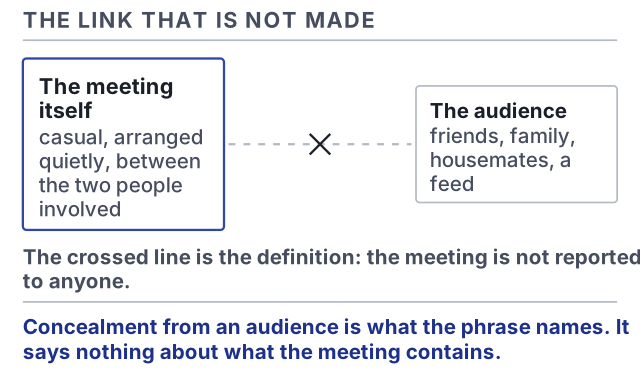
A sneaky link is a low-commitment meeting, usually romantic or sexual, arranged privately and kept out of view of the people who would otherwise hear about it. Concealment is the core. The phrase itself leaves the level of intimacy open.
The word runs in two grammatical slots. As a noun for a person: he’s my sneaky link. As a noun for the event: we had a sneaky link on Thursday. A verb form, to sneaky link, also circulates.
Who the secrecy is aimed at varies and is not fixed by the definition. It can be, for example, a friend group, a family, housemates, coworkers, a social-media audience, or a partner. Popular use often assumes the last of these. That is why the term is often mistaken for a word about betrayal, a different idea, covered below.
What does a sneaky link look like in use?
In use the phrase is applied to a connection someone is seeing and telling nobody about. Consider four scenes that show where the label gets applied. These illustrate vocabulary; they are not signs to measure a person against.
- The unintroduced visitor. Someone is seen regularly but never brought into a friend group, never tagged, never named. Others reach for the phrase because the context is missing, not because they know what the arrangement is.
- The joke about the calendar. The word appears constantly in humour: captions about a Thursday plan nobody was told about, or lists of “sneaky link rules” that are performance more than description. The comic use is now the most common one online.
- The self-description. People apply the label to themselves, sometimes lightly, to name a connection they have chosen not to make public. Used this way it is closer to a status report than an accusation.
- The accusation. The same phrase is thrown in an argument, where it carries the weight of affair while borrowing the casualness of hookup. This is the loosest use, and the one where the word’s meaning is contested — the same scene supports both readings.
Where does the phrase “sneaky link” come from?
The link here is the slang sense of linking up — meeting someone — rather than anything to do with URLs, and sneaky is added to mark the concealment. Which dialects that slang sense of link passed through, and for how long, is not something this entry can source, so it makes no claim about it.
The phrase moved into mass use through short-form video at the turn of the 2020s. It was carried by a track titled “Sneaky Link” that became a widely used sound on TikTok, and by a later sequel version. That is a route of spread, not a coinage. How long the two words had been combined before the sound made them common is not established, and this glossary names no coiner.
Two things follow from that history. First, the term arrived pre-loaded with humour, which is why so much of its use is comic rather than accusatory. Second, its meaning drifted as it travelled. In wider use it has broadened from “a hidden hookup” to “a person kept off the public record.” That is why definitions online disagree with each other.
What is a sneaky link confused with?
A sneaky link is confused with a booty call, with friends with benefits, with a plain hookup, with a situationship, and with an affair.
| Term | What it names | How it differs from sneaky link |
|---|---|---|
| Sneaky link | A casual meet-up kept hidden from other people, or the person met that way | — |
| Booty call | A meeting arranged specifically and immediately for sex | Defined by intent and timing; secrecy is optional, not required |
| Friends with benefits | An ongoing arrangement between people who are also friends | Openly acknowledged between the two, often known to others; friendship is part of it |
| Hookup | A single casual sexual encounter | Says nothing about who knows; a hookup can be public knowledge |
| Affair | A relationship conducted in breach of a commitment | Requires a broken agreement; a sneaky link requires only concealment |
Booty call is the closest older equivalent and the most frequent swap. It specifies what the meeting is for and when it is arranged. Sneaky link specifies who is being kept out of the picture, and leaves the rest open.
Friends with benefits refers to an ongoing arrangement between people who are also friends. It differs on acknowledgement. The arrangement is named between the two people and often known to a wider circle. A sneaky link may be undiscussed even by the pair involved.
Situationship gets swapped in freely in comment sections and is a different word. It describes an undefined ongoing connection rather than a hidden meeting, and it belongs to advice writing elsewhere. Words about how a connection is or is not made public, such as a hard launch, sit on the same axis of visibility but describe the opposite move.
What does sneaky link NOT mean?
Sneaky link does not mean cheating, a relationship status, a personality type, or a hyperlink. The boundary of the term:
- It does not mean cheating. Cheating names a broken agreement between particular people. Sneaky link names concealment from an audience, which is often not a partner at all. The two overlap. Neither implies the other.
- It is not a relationship status. It describes how a connection is handled in public, not what the connection is. Status words like being exclusive answer a different question.
- It does not require sex. Most use assumes it. The phrase is applied to hidden meetings generally, and the humour around it often has no sexual content at all.
- It is not a personality type. Sneaky link is a role in one situation, not a category a person belongs to. This glossary does not label anyone.
- It does not imply anything about consent. The word describes privacy from third parties. Whatever happens between the two people rests on their own agreement. The term neither describes nor excuses it.
- It has no fixed set of rules. The “rules of sneaky link” circulating online are folklore and jokes. They vary by circle and are not part of the definition.
- It is not a hyperlink. In security writing the same two words describe a disguised link. The senses share nothing but spelling.
Where this page stops
This entry defines a phrase. It cannot say whether the phrase describes a specific arrangement, and it deliberately contains no scripts, steps or verdicts.
If reading this touches something heavier than a vocabulary question, take it elsewhere. For pressure, secrecy used against someone, or the fallout of a broken commitment, a licensed professional or a helpline is the right place. A glossary is the wrong instrument for that, and pretending otherwise would be the more harmful choice.
Related entries
Sneaky link sits in the slang hub, where this glossary keeps dated words from group chats and short-form video, including the ick and other terms that arrived the same way. Every entry, including short definition-only lines, is listed in the A–Z index.
Entry checked: 26 August 2026. Usage: current — widely used, with the comic sense now more common online than the accusatory one.