The ick is dating slang for a sudden feeling of repulsion toward someone you were attracted to, usually triggered by a small, trivial detail — a gesture, a phrase, a way of running for a bus — that afterwards cannot be unseen.
The ick meaning that matters in dating talk is narrow: it names a reaction inside the speaker, not a fault in the other person. Not to be confused with the plain interjection ick, an expression of disgust at anything at all, or with ich, the fish disease that shares the sound. Only the fixed phrase the ick, with the article, carries the dating sense.
This is a dictionary entry. It defines a word, traces where the word came from, and marks its edges. It does not tell anyone what to do about a feeling.
What does “the ick” mean?
The ick means attraction ending abruptly, in a way the speaker experiences as involuntary and out of proportion to its cause. Three elements sit inside the definition, and removing any one of them takes the word away.
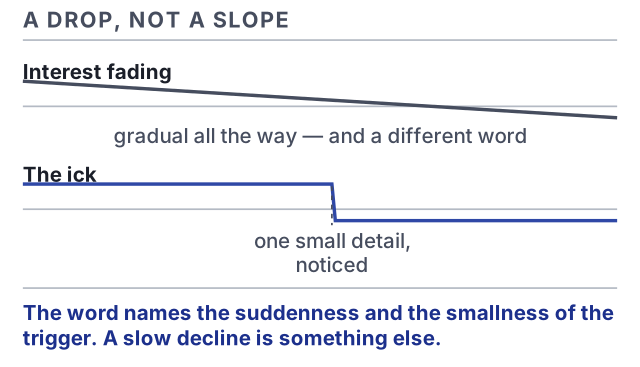
Suddenness. The ick is a switch, not a slope. A slow cooling over months is described with other language — losing interest, drifting — even when it ends the same way.
A small trigger. The classic ick is set off by something harmless and specific, such as a gesture or a turn of phrase. This is the load-bearing part: when the trigger is serious, the word gives way to other language.
Irreversibility, or the feeling of it. People describe the detail replaying, and attraction refusing to return. Whether it actually stays gone is not part of the meaning.
Grammatically the phrase behaves like a possession: you get the ick, someone gives you the ick, a detail is an ick. The plural, icks, names the triggers rather than the state.
What does the ick look like in use?
In use the phrase names one small detail as the moment attraction stopped. Consider four scenes that show where the label gets applied. These illustrate the vocabulary; they are not signs to measure anyone against.
- The list video. Someone reads out triggers to camera — chasing a hat down the street, saying “cheeky” — and the comments add more. This is the format that carried the phrase into short-form video.
- The retroactive report. A date went well, and afterwards one detail is named as the moment the interest died. The word is applied looking back, once the ending needs an explanation.
- The apology in advance. “I know it’s an unfair ick, but…” — the built-in disclaimer, marking the reaction as unreasonable while reporting it, is part of how the word is used.
- The long-relationship sense. Used by someone years into a partnership, icks usually means small ongoing irritations. This is the loosest use and the furthest from the original sense of a sudden collapse.
Where does the word “ick” come from?
The word comes from the ordinary adjective icky, with the fixed dating phrase the ick attaching to it far later. Two layers, and only one of them is traceable.
The adjective is old and ordinary. By the Online Etymology Dictionary’s record, icky — “sticky and repulsive”, “distasteful” — is 1930s American English, originally jazz-scene slang for over-sentimental music, with the clipped interjection ick in the same family. Nothing about that layer is specific to attraction, and it settles nothing about the fixed dating phrase.
The fixed phrase the ick, meaning a sudden loss of desire for a particular person, is where the record thins out. Dictionary.com’s slang entry credits the dating sense to a late-1990s episode of the American legal comedy-drama Ally McBeal, in which a character uses the phrase for exactly this reaction. The honest reading of that: the credit rests on dictionary and encyclopaedic records rather than on a first-attestation study, and sources differ on the exact year — so this glossary reports the attribution and claims no more than the record does.
The route into wider use is described in the same entry, and with the same care: British reality television — Love Island — “seems to have helped popularize” the phrase in the later 2010s, after which it spread on social media into the early 2020s. That hedge is the source’s own, and this glossary keeps it rather than upgrading a plausible route into a cause. Any figures attached to that spread circulate as folklore; there are no approved numbers here and the ones that float around are not repeated.
What is the ick confused with?
The ick is confused with a red flag, with a dealbreaker, with the wider category of a turn-off, and with cringe.
| Term | What it names | How it differs from the ick |
|---|---|---|
| The ick | A sudden collapse of attraction, set off by a small detail | — |
| Red flag | A behaviour read as a warning about the other person | Points at conduct; the ick points at the speaker's own reaction |
| Dealbreaker | A condition someone has decided in advance they will not accept | Decided beforehand and reasoned; the ick arrives uninvited |
| Turn-off | Anything that reduces attraction, broadly | The wider category; every ick is a turn-off, not every turn-off is an ick |
| Cringe | Second-hand embarrassment at something awkward | A social judgement about the act; the ick is specifically about desire |
Red flag is the swap that changes the meaning most. A red flag makes a claim about another person’s behaviour; the ick makes a claim about the speaker’s own body. Speakers sometimes use the ick to soften a genuine warning, which blurs the two, but the words point in opposite directions.
Dealbreaker is deliberate where the ick is involuntary. A dealbreaker exists before the date; an ick is manufactured on the spot by a detail nobody could have predicted.
Cringe is about awkwardness in general. For instance, something can be cringe without touching attraction at all, which is why the two words are not interchangeable even when they land on the same moment.
Distinguish the ick from the earlier states as well. Infatuation and limerence name intensified attraction; the ick names its sudden absence. The words describe opposite ends of the same axis, not stages of one process.
What does “the ick” NOT mean?
The ick does not mean a verdict on the other person, a red flag, a diagnosis, or general disgust. The boundary of the term — the part trend lists skip:
- It is not a verdict on the other person. The definition sits with the speaker. Most reported triggers are harmless, and the word carries no claim that anyone did wrong.
- It is not a red flag. Slang about warning behaviour is a separate vocabulary with a different subject.
- It is not a diagnosis, of anyone. Neither the person who gets the ick nor the person who gives it is being described as having a condition. This glossary does not assess people.
- It does not mean general disgust. The bare interjection ick applies to spoiled milk. The ick, with the article, is specific to desire for a person.
- It does not require a breakup. The word names a feeling and says nothing about what follows it.
- It is not permanent by definition. Speakers often describe it that way; the term itself makes no claim about duration.
- It is not a gendered term, despite the gendered look of its most visible use.
- It is not the same as ending things over something serious. When the trigger is serious, the small-detail element that defines the word is missing.
Where this page stops
This entry defines a phrase. It cannot say whether the phrase fits a particular person or feeling, and it deliberately contains no advice, scripts or verdicts.
If a reaction to someone is heavier than an odd flinch at a small detail — closer to fear, or to distress that does not lift — a licensed professional or a helpline in your country is the right place for it. A glossary is the wrong instrument for that, and pretending otherwise would be the more harmful choice.
Related entries
The ick sits in the slang hub with the other dated words this glossary keeps for how people talk about attraction. Every term, including short definition-only lines, is listed in the A–Z index.
Entry checked: 26 August 2026. Usage: current — established in general dating vocabulary in English, with the plural sense drifting toward “minor irritations”.