A thirst trap is a photo or video posted online in order to attract attention to the poster’s attractiveness, usually presented as though it were about something else — a workout, an outfit, a view. The word names a post and its apparent aim.
This is a dictionary entry, so it covers what the phrase means, where it came from, which words it gets swapped with, and where its meaning ends. It does not evaluate anyone’s posts and gives no advice about posting.
What does “thirst trap” mean?
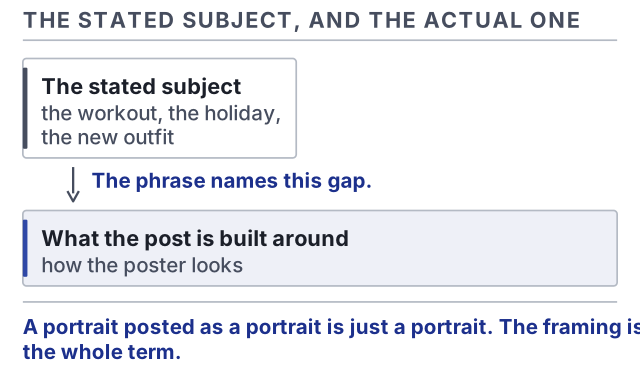
Thirst trap meaning, in full: content shared publicly whose real subject is how the poster looks, wrapped in a nominal subject that is something else. Two parts do the work. Thirst is slang for visible, unembarrassed wanting. The trap is the bait laid out for it.
The wrapper matters. For example, a straightforward portrait posted as a portrait is rarely called a thirst trap; the label attaches when there is a stated reason for the post that the post does not really serve. The gap between caption and content is the whole joke inside the word.
It is used as a noun (that’s a thirst trap), a verb (thirst trapping) and an adjective (a thirst-trappy caption). Merriam-Webster added the phrase to its dictionary in the early 2020s, in its published batch of new dictionary words.
The tone is unstable by design. Between friends it is teasing or admiring; from a stranger in a comment section, or from a partner, it can be an accusation. The dictionary sense does not change between those uses — the judgement attached to it does.
What does a thirst trap look like in use?
In use the label is applied to a post whose stated subject is not what the post is for. Consider four scenes where it typically gets applied. These illustrate a word; they are not signs to measure anyone against.
- The gym mirror. A progress update on a training routine, framed so the routine is not what anyone is looking at. The stock illustration of the form.
- The incidental holiday shot. A photo captioned with the name of a beach, in which the beach occupies a corner of the frame.
- The pointed re-entry. Someone posts a noticeably flattering picture soon after a relationship ends. Onlookers read intent into the timing, which is a reading, not a fact.
- The joke on the form itself. The caption announces “thirst trap” outright — the device named as it is used.
Where does the word “thirst trap” come from?
The compound comes out of early social-media use: Dictionary.com’s slang entry for thirst trap places the phrase on Twitter and in Urban Dictionary at the start of the 2010s, built from thirsty plus trap in the sense of a lure. The base is thirsty, slang for wanting something so openly that the wanting shows. Where that slang sense of thirsty itself began is not established in the references this entry could check, and no origin is invented here to fill the gap.
No individual coiner is on record, and this entry names none. What the record does carry is attestation. By the late 2010s the phrase was in mainstream English-language press: Wiktionary’s dated quotation set for thirst trap collects examples from newspapers and magazines of that period, and its dictionary entry followed in the early 2020s.
This page records the venue and the era for this one word. It makes no claim about how other dating vocabulary travelled, and none about what a dictionary entry signals in general.
What is a thirst trap confused with?
A thirst trap is confused with thirsty, with catfishing, with a hard launch, and with a sneaky link.
| Term | What it names | How it differs from a thirst trap |
|---|---|---|
| Thirst trap | A post aimed at attention for the poster's attractiveness, framed as being about something else | — |
| Thirsty | The state of wanting attention or someone, visibly | Describes a person's manner; a thirst trap is an object they post |
| Catfishing | Using a false identity online, including someone else's photos | Turns on deception about who is posting; a thirst trap is genuinely the poster |
| Hard launch | Making a relationship public and explicit | Announces a partnership; a thirst trap points at the poster alone |
| Sneaky link | A meeting kept private | Names a private arrangement; a thirst trap is by definition public |
Thirsty is the closest relative and the usual swap. It labels a manner — of commenting, texting, replying — while a thirst trap is a thing that exists on a feed. For instance, a person can be called thirsty without posting anything.
Catfishing sits at the opposite end. Its defining feature is a false identity; a thirst trap involves no claim about who the poster is. Catfishing is a separate entry for exactly that reason.
Hard launch is about relationship visibility rather than personal attention — see hard launch for how that pairing works. A soft launch, the hinting version, belongs to that same comparison and is defined in full elsewhere on the wider web, not here.
Sneaky link points the other way entirely: it names something kept off the feed. Where a thirst trap depends on an audience, that term depends on there not being one.
What does “thirst trap” NOT mean?
A thirst trap does not mean a personality type, nudity, deception, or availability. The edge of the term — the part trend listicles usually skip:
- It is not a personality type. The word describes a post. “A thirst trap” applied to a human being is loose usage, and it borrows a judgement the definition does not contain.
- It does not mean nudity. Nudity is not part of the definition: a fully clothed post can be a thirst trap, and a revealing photo need not be one. Framing, not skin, is what the word tracks.
- It does not mean deception. Editing, angles and flattering light are ordinary; a false identity is a different word.
- It does not mean the poster is single, available or interested in you. The term says nothing about relationship status or intent toward any particular viewer.
- It does not describe one gender. The definition is not gendered.
- It is not a verdict on the post’s quality or the poster’s confidence. Motive is not in the meaning. Attention, humour, promotion and habit all produce the same object.
- It is not, in ordinary use, a literal trap involving thirst. The compound is metaphor end to end; the only sense in circulation is the social-media one.
Where this page stops
This entry defines a word. It cannot say whether the label fits any particular post, and it carries no rules about what anyone should post or how to read a partner’s feed — those are questions about specific people and specific agreements, which a glossary knows nothing about.
If the reason for looking the phrase up is heavier than curiosity — images shared without consent, pressure to post, or harassment following a post — a licensed professional or a helpline in your country is the right place to take it. A vocabulary page is the wrong instrument for that, and pretending otherwise would help no one.
Related entries
Thirst trap sits in the slang hub alongside the other dated entries this glossary keeps for words that move fast. Every term the dictionary covers, including short definition-only lines, is listed in the A–Z index.
Entry checked: 26 August 2026. Usage: current — the word is in general use, including in self-aware, joking use.