Catfishing means running an invented online identity to form a relationship with someone who believes it is real. The photographs are typically taken from another person. The name, job or life story does not belong to the sender. The deceived person is catfished; the sender is a catfish.
Not to be confused with the animal, or with the hand-fishing technique also called catfishing (noodling). The dating sense borrows the name from a film. The film borrowed it from a story about the fish. The rest of this entry keeps to the dating sense.
What does catfishing mean?
Catfishing names a deception about who is there, not about how someone behaves once they arrive. The test the word applies is simple. If the two people ever met, would the person in the photos be the person who has been messaging? Where the answer is no, the word fits.
The term describes the conduct and says nothing about the motive behind it. Documented motives such as financial schemes, boredom, loneliness and harassment have all been given. So have experiments with a different presentation of self. The word covers all of them equally. That neutrality about motive is what makes catfishing a broader term than scam.
What does catfishing look like in use?
In use, catfishing is applied to an account whose photographs and life story do not belong to the person sending the messages. Consider four scenes that show how the word is used in ordinary talk. These are illustrations of usage, not a checklist to measure anyone against.
- The borrowed face. A profile uses photos of someone else entirely, often lifted from a public social account or generated. The person messaging has no connection to the images. This is the core case the word was coined for.
- The relationship that never reaches a camera. Months of messages and voice notes, with video calls declined each time for a new reason. Commentators reach for the word here because the persona survives only as long as it is never seen.
- The invented biography. Real photos, but the job, the city, the marital status or the age belong to a life that does not exist. Usage is split on this one. Some people reserve the word for cases where the face is false too.
- The plural profile. One person keeps several personas going at once, sometimes talking to the same target from two of them. Writing on the subject treats this as a standard variant rather than a separate case.
Where does the word catfishing come from?
The word comes from Catfish, released at the start of the 2010s. The documentary follows an online relationship built on an invented identity. The origin is documented, which is unusual for dating slang. The film’s world premiere at the Sundance festival is reported in the International Documentary Association’s festival dispatch on Catfish. Its success produced the long-running MTV series Catfish: The TV Show. Each episode unmasks one such identity, and the title became a verb.
The metaphor itself comes from an anecdote told near the end of the film: that live cod shipped in tanks arrive sluggish, so catfish are put in with them to keep them moving. The speaker uses it to describe people who keep others alert. Treat that story as folklore about the fishing trade rather than as fact. Its value here is that it explains the name, not that it describes any real shipping practice.
The word spread from television into general online use across that decade. It now appears in mainstream dictionaries and in platform safety pages. Unlike most app-era coinages, it did not start in a community and then get picked up by media. It went the other way.
What is catfishing confused with?
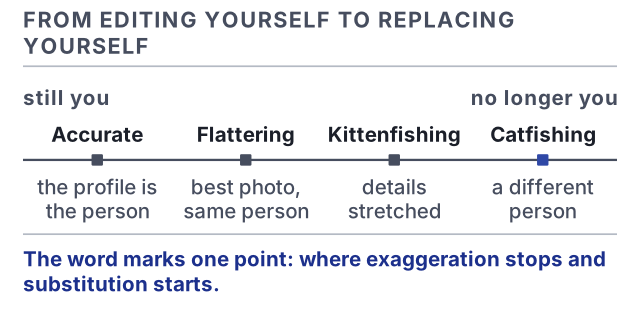
Catfishing is confused most often with romance scams, kittenfishing and plain impersonation. The table below sets out where each one differs.
| Term | What it names | How it differs from catfishing |
|---|---|---|
| Catfishing | An invented identity used to build a relationship online | — |
| Kittenfishing | A real person presented with flattering exaggeration | The sender still exists; only the details are stretched |
| Romance scam | Deception aimed at extracting money | Defined by the financial goal; catfishing is defined by the false identity, with or without money involved |
| Bot or spam profile | Automated or bulk-run accounts | No individual relationship is being maintained; catfishing needs a sustained one-to-one persona |
| Impersonation | Posing as a specific named real person | Aims at a real identity that already exists; a catfish persona is usually assembled rather than copied whole |
Romance scam is the mix-up worth spelling out. The two overlap constantly, which is why the words get swapped. They still classify different things. Romance scam names a purpose: money. Catfishing names a method: a persona that is not the sender. A scam can run from a real face and a real name. A catfish may never ask for anything at all.
Kittenfishing is the second confusion, covered in the table above and in the FAQ. The line is substitution versus exaggeration. Most arguments about whether a given profile “counts” are really arguments about where that line sits.
The third is with the vocabulary of disappearing. The words for going quiet, resurfacing or stringing someone along describe how a real person handles a real connection. Those terms are covered elsewhere and are not what this one means. Within this glossary, the nearest neighbours are micro-cheating and breadcrumbing. Both assume the person is who they say they are.
What does catfishing NOT mean?
Catfishing does not mean a flattering photograph, a pseudonym, or fraud by default. The edge of the term is the part most lists skip.
- It does not mean a flattering photograph. An old picture, a good angle or a rounded-up height is kittenfishing at most. The profile still points at the person sending messages.
- It does not mean someone looked different in person. Disappointment is not the criterion; a different person is.
- It does not mean any use of a pseudonym. People use partial names, blurred photos and separate accounts for reasons such as safety, work or privacy. The word applies when a persona is built to be believed as a whole self, not when identifying details are withheld.
- It does not mean fraud by default. Money is common in the surrounding coverage but is not part of the definition. Calling every catfish a scammer collapses two useful words into one.
- It is not a legal category. The slang has no fixed statutory meaning. Specific acts that may accompany it are handled by law separately, and differently in each country.
- It is not a statement about the other person’s psychology. The term describes what an account does. It offers no account of why anyone does it. Treating the word as an explanation of someone’s mind is a misuse of it.
- It does not mean the relationship was not felt. People describe real attachment formed through a false persona. The word marks the identity as invented, not the experience.
Where this page stops
This entry defines a word. It is not a verification method, not a guide to confronting anyone, and not an assessment of any particular match. Those questions need facts this page cannot see.
If a situation involves money, threats, images used as leverage, or anyone under age, the next step is not a longer definition. Contact the platform, the police, or a helpline. Speak to a qualified professional if the aftermath is affecting you. A glossary is the wrong instrument for that.
Related entries
Catfishing sits in the app-era behaviour hub. That hub holds the other words this glossary keeps for how dating apps changed the vocabulary, including stashing. Every term the site defines is listed in the A–Z index.
Entry checked: 26 August 2026. Usage state: current — the term is in standard use in English-language media, dictionaries and platform safety material, with kittenfishing settled beside it as the milder case.