Infatuation meaning is easy to give in one line. It is an intense, short-lived attraction to a person one barely knows. The attraction runs on an idealised image of them rather than on gathered knowledge of who they are. It is an ordinary English word, not a clinical or community coinage.
Two features separate it from its neighbours. It is defined by what the feeling is built on, which is an impression. It also carries a faint note of disapproval, taken from its Latin root. Calling something infatuation is rarely a neutral report. It is usually a comment on the gap between the feeling and the evidence for it.
What does infatuation look like in use?
The word is used about the shape of an attraction, not about its strength. A few recurring scenes carry the usage.
Someone describes a person they have met twice as the one. They can list the smile, the voice and the job title. They can say nothing about how that person handles a bad week. The certainty runs far ahead of the acquaintance.
Someone hears a friend’s flat account of the same person: late, evasive, not interested. They file it as a misunderstanding. News that clashes with the picture does not change it. It gets absorbed into it.
Someone uses the word about the past, which is where it appears most often: that was infatuation, not love. The past tense is doing real work. Speakers reach for the word once the image has collapsed. Then they can see what the feeling was resting on.
Least flattering: the word gets used about other people as a soft dismissal. He’s just infatuated means the speaker does not consider the attachment serious. That usage says as much about the speaker as about the attraction.
Where does the word infatuation come from?
The English verb infatuate comes from Latin infatuare, formed from fatuus, meaning foolish or silly. That root is set out in Etymonline’s entry for infatuation. The literal sense is to make a fool of someone. English took the verb and the noun over during the early modern period, long before dating words existed as a genre. The first weight of the word was closer to being duped than to being in love.
The romantic narrowing came later. Modern usage keeps only a trace of the old sense. That trace is the reason the word still stings. A feeling called infatuation is being called a feeling built on something that will not hold.
Unlike most entries in this dictionary, infatuation has no origin community, no platform and no coiner. It is old, general English that dating writing borrowed. That is also why it is used loosely: nobody owns the definition.
Infatuation vs love: what is the difference?
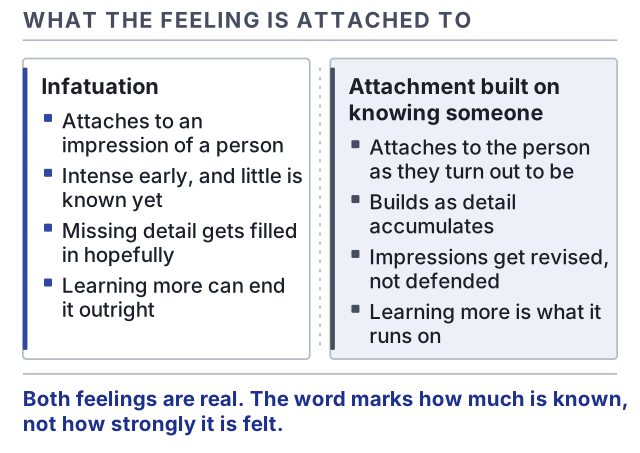
Ordinary usage draws the line at what the feeling is built on, not at how strong it is. Infatuation attaches to an image, and it tends to weaken when true facts arrive. Love, as the word is normally used, is expected to survive true facts. The research on adult romantic love comes at the subject from a different direction than the everyday word does. It works through attachment, for instance, as in the record for Hazan and Shaver, Romantic love conceptualized as an attachment process.
| Term | What the word points at | Key difference from infatuation |
|---|---|---|
| Infatuation | Fast, intense attraction resting on an idealised image | — |
| Love (long-term sense) | Attachment to a person as actually known, usually with commitment | Built on accurate information rather than on an impression; not defined as a phase |
| Crush | Casual attraction, light register | Lower stakes and no implication of impaired judgement |
| Limerence | Involuntary obsessive longing fed by uncertainty | Names an involuntary state with intrusive thought; infatuation names a phase and an image |
| New relationship energy | The heightened early period inside a relationship that exists | Describes a real, mutual beginning; infatuation does not require the other person's involvement |
| Passion | Intensity of desire, neutral about its basis | Says nothing about whether the picture of the person is accurate |
The pair that draws most searches is infatuation and love. The two words are not measured on one scale. Nothing in the definition of infatuation says the feeling is small. It says the feeling is under-informed.
What is infatuation confused with?
Infatuation is confused most often with limerence. After that it is confused with new relationship energy and love bombing.
Limerence is the nearest neighbour and the more technical word. It was coined in psychology writing for an involuntary state of obsessive longing. Infatuation is the common word for a phase of idealised attraction. Speakers who choose limerence usually mean they did not feel they had a choice. See the limerence entry for that word on its own terms.
New relationship energy refers to the charged opening stretch of a relationship that both people are in. Infatuation carries no such demand, and it often runs one-sided. The new relationship energy entry covers the difference in detail.
Love bombing refers to a pattern of behaviour, meaning what someone else does. It belongs to that literature, not to this one. Online writing swaps the two often, and the swap is a mistake worth naming. Infatuation describes a feeling inside the person who has it. Using infatuation for another person’s conduct empties both words.
What infatuation does not mean
It does not mean the feeling is fake. The word describes what an attraction rests on, not whether it is truly felt. Intensity is not in dispute. The basis is.
It does not mean a diagnosis. Infatuation appears in no diagnostic manual. It is everyday English. No amount of therapy-adjacent content on social platforms turns it into a condition.
It does not mean love will not follow. The term describes the present state of an attraction. It is not a forecast. Usage allows the same relationship to be described with different words at different times.
It does not mean an insult, though it is often used as one. The dismissive sense, for example just infatuated, is a usage, not the definition. Readers should notice which one they are being handed.
It does not mean a fixed length. No agreed length of time exists. Month counts repeated across popular articles are folklore, not findings, and this entry does not print them.
It does not mean the other person did anything. Infatuation makes no claim about the conduct of the person it is aimed at. That person may not know the feeling exists.
Where this page stops
This is a dictionary entry. It defines a word. It does not assess anyone, diagnose anyone, or advise anyone on what to do about a particular relationship.
The search behind this page may be heavier than vocabulary. Thoughts about one person may not stop. Sleep, work or safety may be affected, or someone else’s behaviour may be frightening. That belongs with a licensed professional or a helpline in your country, not with a glossary.
For the surrounding words for inner states, see the states and feelings hub. The full A–Z index of dating terms is there if you arrived here with a different word in mind.
Checked: 26 August 2026. State: current — infatuation is long-established general English, stable in meaning, and re-read here as its dating-specific usage shifts.