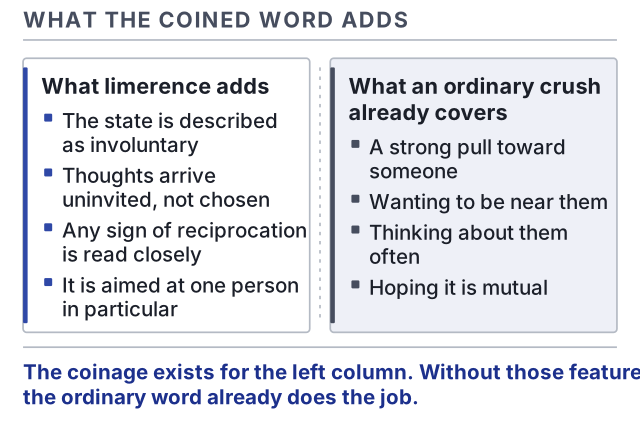
Limerence meaning is best given in one line. It is an involuntary state of intense romantic longing aimed at one person. It is marked by intrusive thoughts about them. Mood rises and falls on small signs of interest. The craving is for a return of the feeling rather than for company. The word is descriptive, not clinical.
It is a coined term with a named author. That makes it unusual in dating language. Most of the words in this dictionary came out of forums and short video. This one came out of a book. It is often misspelled limerance, and it has nothing to do with limerick, the verse form.
What does limerence look like in use?
The word gets used about the shape of attention, not about the strength of a couple. Consider three scenes that carry most of the usage.
A person checks one chat thread before any other. They reread replies they have already read. They rehearse conversations that have not happened. Nothing has been agreed with the other person, and the whole day still tilts around them.
A person calls a mutual friend to decode a single sentence: what was meant, what the pause before it meant, whether the emoji was warmth or manners. Small unclear signals get more study than clear ones.
A person keeps the state going for months without contact. Sometimes it is about someone out of reach, sometimes about someone barely known. That is the usage that separates the word from a plain crush. It survives on hope rather than on a relationship.
Where does the word limerence come from?
Limerence was named by the American psychologist Dorothy Tennov. She introduced it in her book Love and Limerence: The Experience of Being in Love (1979). Tennov built the term from interviews and questionnaires with people describing romantic obsession. She coined a new word because the old ones, such as love, infatuation and crush, were carrying too many meanings at once.
Tennov stated she invented the word rather than taking it from Latin or Greek. No etymology beyond her coinage is established, and accounts that give one are not backed by the source.
The word stayed largely inside psychology and self-help writing for decades. Its move into everyday dating language is recent, driven mainly by short video and relationship forums. That is why the entry is marked rising rather than current. Usage is spreading, and spreading usage is where meaning drifts.
What is limerence confused with?
The word sits next to several others it is routinely mixed up with. The notes below are about the words, not about which experience is more real.
| Term | What the word points at | Key difference from limerence |
|---|---|---|
| Limerence | Involuntary obsessive longing for one person, fed by uncertainty | — |
| Infatuation | Short, intense attraction, often to an idealised image | Usually described as briefer and less involuntary; no requirement of intrusive thought |
| Crush | Casual attraction, everyday register | Low-stakes and conversational; nobody uses it to describe months of preoccupation |
| Obsession | Broad term for fixation on anything | Not specifically romantic, and carries a clinical shadow the coined term deliberately avoids |
| Parasocial attachment | One-sided bond with a public or unreachable figure | Defined by the absence of mutual acquaintance, not by the quality of longing |
The pair that matters most for search is limerence and infatuation. Infatuation refers to a phase of idealised attraction. Limerence is the word people apply to a state they feel they did not choose. Parasocial attachment refers to a one-sided bond with a public or out-of-reach figure. It is defined by the lack of mutual acquaintance rather than by the quality of longing. See the neighbouring entries on infatuation and parasocial relationships for how each of those words behaves on its own.
What limerence does not mean
This is the part most listicles skip. It is the part that keeps the word usable.
It does not mean love. The two are usually set against each other rather than nested. Limerence is described as running on doubt, and as fading when the doubt clears. Long-term love is described as running on knowledge of a real person.
It does not mean a diagnosis. Limerence is not in any diagnostic manual. It is a descriptive coinage from a book. No amount of everyday use turns it into a clinical category.
It does not mean a red flag in the other person. Limerence describes the inner state of the one feeling it. Words for what someone else is doing, for example manipulation, mounting attention or pressure, belong to a different set. Using limerence for them empties the term.
It does not mean intensity is proof of anything. The word makes no claim that the feeling predicts a match, a return of the feeling, or an outcome. That claim is imported by readers, not built into the definition.
It does not mean a relationship exists. Limerence can run wholly on one side, and often does. The word says nothing about whether the other person knows.
What about “the four stages of limerence”?
The four stages are a popular story model, not part of the definition of limerence. The staged version — infatuation, crystallisation, deterioration, resolution — travels widely on social platforms and in coaching material. Treat it as folklore built on top of Tennov’s term rather than as part of the definition. It is a story shape people find useful for retelling their own experience. It is not a documented sequence, and this dictionary does not endorse it as one.
The same applies to “root cause” content. A cause for limerence is not established, and entries that supply one are supplying a reading of their own. Limerence is not a category in the research literature on psychology, which comes at romantic love from a different direction. The record for Hazan and Shaver, Romantic love conceptualized as an attachment process shows what that literature works with instead.
Where this page stops
This is a dictionary entry. It defines a word and does not assess anybody, diagnose anybody, or advise anybody on what to do next.
The experience behind the search may be heavy. The thoughts may not stop. Daily life, work or sleep may be suffering, or the feelings may involve harm to yourself. That belongs with a licensed mental-health professional or a helpline in your country, not with a glossary. No definition, including this one, stands in for that conversation.
For the wider set of words for inner states, see the states and feelings hub. Scan the full A–Z index of dating terms if you arrived with a different word.
Checked: 26 August 2026. State: rising — the term is expanding out of psychological writing into general dating vocabulary, and this entry is re-read as that usage settles.