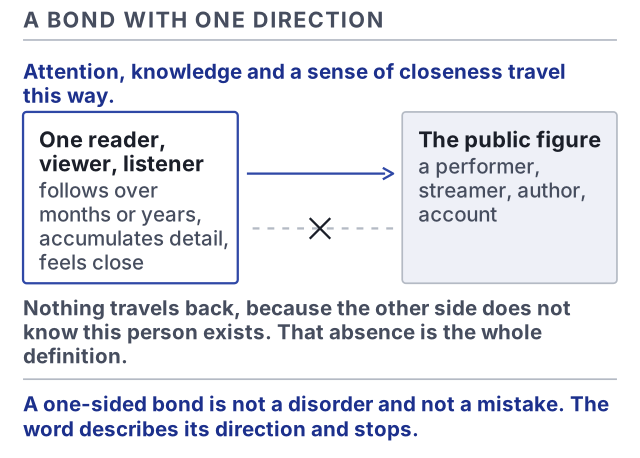
Parasocial relationship meaning is best given in one line. It is a lasting one-sided bond. A person feels familiarity, loyalty and sometimes affection toward a figure who does not know they exist. That figure may be a performer, streamer, author, public account or fictional character. The term describes a lopsided bond, not attraction.
This word is bigger than dating. It comes from media research. Today it is used in writing about fandom, politics, marketing and chatbot companions. This entry keeps to the dating and attachment sense that brings most readers here. It flags the wider field where that matters.
What does a parasocial relationship look like in use?
The word is used about the direction of a bond, not its intensity. Consider four scenes that carry most of the everyday usage.
Someone follows a streamer for years. They know the names of the pets, the coffee order, the opinions on everything. They feel a real drop when a stream is cancelled. The streamer has never read a message from them.
Someone describes a break-up-shaped grief when a podcast ends or a creator quits. The reaction is hard to explain to the people around them. The word gives that reaction a name without calling it a symptom.
Someone in the dating context builds months of feeling out of a profile, a public feed and a handful of viewed stories. All of it comes long before any exchange. That use stretches the first meaning, but it is common enough now to count as usage.
Someone talks daily to an AI companion app and calls the attachment parasocial. This is the newest and fastest-moving corner of the word. It is part of why the term is marked rising.
Where does the word parasocial come from?
Parasocial comes from mid-century media research. Sociologists Donald Horton and R. Richard Wohl introduced para-social interaction in an article in the journal Psychiatry in the mid-1950s, describing how radio and television audiences responded to performers as though to people they knew. A named paper is an unusually firm origin for a word that later ended up in dating talk — though what it fixes is the naming of the term, and nothing about how common such bonds are. The prefix para- means alongside: a relationship running beside the real thing rather than inside it.
Horton and Wohl’s first object was the single encounter. Parasocial interaction refers to that unit: the broadcast in which a host appears to speak straight to the viewer. The relationship sense means the bond that lasts between encounters. Later media researchers built that sense, and it is the one the internet inherited.
Its arrival in dating language is recent. Streaming platforms and short video drove it, because the gap between audience and performer is narrow enough to feel like acquaintance. No single account, community or publication is established as the point where it crossed over.
What is a parasocial relationship confused with?
The word sits next to several others it is routinely mixed up with. These are notes about words, not judgements about which experience is more real.
| Term | What the word points at | Key difference |
|---|---|---|
| Parasocial relationship | Enduring one-sided bond with someone who does not know you | — |
| Parasocial interaction | A single episode of feeling addressed by a performer | One encounter, not a bond carried across time |
| Limerence | Involuntary obsessive longing fed by uncertainty | Names an internal state; the target is usually reachable in principle |
| Infatuation | Short, intense attraction to an idealised image | About intensity and brevity, not about asymmetry |
| Celebrity crush | Casual attraction to a famous person | Light register, no claim of sustained familiarity or loyalty |
| Fandom | Shared enthusiasm, usually collective | A group activity and identity, not a one-to-one bond |
The pair worth separating carefully is parasocial and limerence. Limerence is about how the feeling behaves inside one person. Parasocial is about the wiring between two positions, one of which is empty. The two can describe the same situation from different angles. That is why writers often stack them. Compare the neighbouring entries on limerence and infatuation.
What a parasocial relationship does not mean
This is the boundary section. For this term it does most of the work.
It does not mean a delusion. The definition assumes the person knows the bond is one-sided. Believing the feeling is returned when it is not is a different claim. This word does not make it.
It does not mean a diagnosis. Parasocial appears in media research, not in diagnostic manuals. It is a description of a common feature of media use. Its spread on social platforms does not turn it into a clinical category.
It does not mean an insult to fans. The term is often thrown as one online. In its first and technical use it is neutral. It applies to anyone who has ever felt they know a host they have never met.
It does not mean romantic. Plenty of parasocial bonds are admiration, comfort or a sense of company. Romance is one possible content of the bond, not its definition.
It does not describe imbalance inside a mutual relationship. Imagine a couple in which one partner puts in far more than the other. That pattern belongs to other words, for neglect and imbalance. Both people know each other, so the term does not apply.
It does not mean the same as being a fan. Enjoying someone’s work is not a bond. The word implies a bond carried across time, familiarity and a felt relationship, not viewing figures.
Is the term only about dating?
No. Pretending otherwise would misdescribe it. Parasocial began in television research. Today it is used across fields such as fandom studies, political communication, influencer marketing and the new writing on AI companions. Dating is one corner of a much larger field.
The dating-adjacent uses are the ones still visibly drifting: one-sided attachment formed through feeds, dating profiles as performance, and chat interfaces that answer without knowing anyone. Where a term is drifting, definitions age quickly. That is why this entry carries a date.
Where this page stops
This is a dictionary entry. It defines a word. It does not assess anyone’s attachments, label anyone’s fandom, or advise anyone on what to change.
The search behind the word may be heavy. A one-sided attachment may be crowding out sleep, work, money or the people nearby, or the feelings may involve harm to yourself. That belongs with a licensed mental-health professional or a helpline in your country. A glossary cannot do that job, and this one does not try.
For the wider set of words for inner states, see the states and feelings hub. Scan the A–Z index of dating terms if you arrived with a different word in mind.
Checked: 26 August 2026. State: rising — usage is expanding well past its media-research origin, and this entry is re-read as that expansion settles.