Pansexual means being drawn to people regardless of gender. The word names attraction that is not filtered by whether someone is a man, a woman, non-binary or anything else. People use it of themselves.
The search that brings most people here is a match-up: pansexual versus bisexual. The plain part comes first. The two words overlap a great deal. Both sit under the same umbrella, and neither is a fixed-up version of the other. This entry sets out how each group defines its own word, and stops there.
What does pansexual look like in use?
The word turns up in a few settings that recur, and its job shifts a little in each. Consider three of them.
On dating apps it is a field to fill in: “pan” next to pronouns in a bio. It works as a filter and a signal that the profile is not fenced in by gender. It says who attraction can point toward. It says nothing about what the person wants from any one match.
Among people who already use these terms, it is short and flat. Someone says they are pan the way they would say they are left-handed. No explanation is attached, and none is expected.
In coming-out talk the two words are used together: “bi, or pan, depending on who’s asking.” That is not dithering. One word takes less explaining in general company. The speaker keeps the other for the room where it lands.
Where does the word pansexual come from?
The identity sense grew inside queer and bi community spaces. The prefix is far older. Pan- is Greek for “all”, tacked on to sexual on the same pattern as other orientation words such as homosexual and bisexual.
In that bare form the word is old. But its older use is not the one in force now. By the Online Etymology Dictionary’s entry, pansexualism was a term of reproach in early twentieth-century psychology. It named the view that the sex drive plays the leading part in all human doings. Freud’s critics pinned that view on him; he did not state it. That sense is dead, and it has no tie to the identity label.
The modern sense is a word claimed by the people it names. The same Etymonline entry records it in English by the 1970s, glossed as a person not limited in sexual choice with regard to gender. So the word was not first written down as an identity in the internet age. It spread from community spaces across forums, and came into plain view in the 2010s as public figures used it of themselves. What that decade brought was sight of the word, not the first record of it. The lexicographic record dates the sense without naming a coiner, and this entry does not invent one.
Pansexual vs bisexual: what is the difference?
There is no settled, shared answer, and this entry does not pretend otherwise. What follows is how each word is defined by the people who use it.
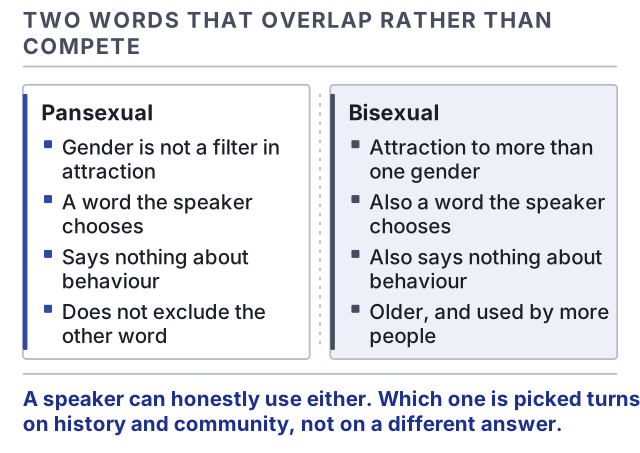
Bisexual means attraction to more than one gender. That is how bi groups phrase it of themselves. The Bisexual Resource Center puts it as sexual and emotional attraction to more than one gender. Robyn Ochs’ widely used wording adds that this need not be at the same time, in the same way, or to the same degree. In those wordings the bi points at genders like one’s own and genders unlike one’s own — not at a cap of two. This entry passes on each group’s own wording and claims nothing about other times.
Pansexual is phrased as attraction regardless of gender. Gender is not a factor in whether attraction happens.
Set side by side, the two mark shared ground rather than rival claims. Both sentences can fit the same person, who then picks the one that suits them — or uses both, or uses queer instead.
Where the split is real, it is about stress, not about who counts. Some bi speakers argue that pan wordings cast bi as a matter of two. Some pan speakers argue that no other word says plainly enough that gender is not part of the sum. Both stands exist, and both are held in earnest. This dictionary names the argument and does not decide it.
The upshot: neither word ranks above the other. The right word for a person is the one that person uses.
What is pansexual confused with?
Most often with bisexual, omnisexual and polysexual, and after those with demisexual, asexual and bicurious.
Bisexual. Covered above: overlapping definitions, different emphasis, one shared umbrella. Not a hierarchy.
Omnisexual. Also names attraction across all genders. The usual split: with omni, gender is still noticed and still shapes how attraction feels. With pan, gender does not register at all. The line is fine, and not everyone draws it in the same place.
Polysexual. Attraction to many genders, though not all. By its own wording it is narrower than pan or omni.
Demisexual. A different axis. It says when attraction shows up: after closeness. It says nothing about which genders it can point toward. Someone can be both pan and demi with no clash.
Asexual. Little or no sexual attraction. Pansexual is not a stronger form of any label, and asexual is not its opposite. The ace spectrum and multi-gender attraction are two questions, not one. Some people use words from both.
Bicurious. Someone looking beyond their old guesses about who they are drawn to. It names a stage a person claims for themselves. It is not a smaller dose of pan.
What does pansexual not mean?
It does not mean attracted to everyone. This is a recurring misreading of the pan- prefix. The word says gender does not filter attraction. It claims nothing about taste, standards or type. Pan people have those like anyone else.
It does not mean attracted to objects, or to anything other than people. That has nothing to do with this word. Repeating the joke as a meaning is simply wrong.
It does not mean gender-blind. The word does not claim that gender goes unnoticed. It states that gender does not decide whether attraction happens — that is the whole of the claim.
It does not call for a track record. These words name attraction, not a list of past partners. Someone can, for example, be pan and single, pan and partnered, or pan and with one partner of one gender for decades.
It does not replace or fix bisexual. The two sit side by side. Any story in which one word arrives to correct the other gets both groups wrong.
It is not a phase, a fashion or a diagnosis. This dictionary records how people name themselves. It does not judge whether the name is earned. No page here explains “why someone became” anything.
Where this page stops
This entry defines a word. It reports how each group defines it against the word next door. It is not advice about naming yourself, coming out, or picking a label. Those choices belong to the reader, and a dictionary is the wrong tool for them.
Some readers arrive here with distress, pressure, or an unsafe home. The useful next step there is a trained professional or a helpline, not a longer definition.
Related orientation terms are indexed in Identity and orientation.
Checked: 26 August 2026. Usage state: current — pansexual is in standard use in English-language media and dictionaries, and the pan/bi line is still argued over rather than settled.