Bicurious is a self-description for someone who mostly identifies as straight, gay or lesbian. The word marks curiosity about attraction to a gender they have not pursued before. It stops short of claiming a settled bisexual identity. It is a word people apply to themselves.
The spelling varies. Bicurious and bi-curious are the same word, and the hyphen carries no difference in meaning. Search interest in the term has been climbing rather than fading. That is why it is marked here as rising rather than current.
What does bicurious look like in use?
The word marks an open question. It is not a conclusion and not a record of behaviour. Consider three scenes that carry most of the everyday usage.
Someone lists bicurious on a dating profile as a note about accuracy. The profile is otherwise read as straight. The word flags that the picture is less settled than the rest of the page suggests.
Someone uses it in talk as a placeholder while an answer is still forming. The point is that a question is open and has not been settled either way. The word does its work by being provisional.
Someone uses it about the past, describing a stretch of time when the question was live. A different label — bisexual, straight, or none at all — later fit better. The term survives in the account of that period even after it stopped applying.
Where does the word bicurious come from?
It comes from the tight language of personal advertisements. Dictionary.com’s entry for bi-curious records the word as arising there in the late twentieth century. It is built from bi-, clipped from bisexual, plus curious. The build follows the same pattern as other short self-descriptions in classified advertising. The term appears in English-language personal ads. It shows up later in early online personals and chat rooms, where short labels did a lot of work in very little space.
No single coiner is on record. Dictionaries do not agree on one decade. So this entry records the venue rather than a founding text.
That advertising history matters for one reason. The word arrived loaded with the shorthand of personals language, where every term was also a signal to strangers. Some of the dispute about the term today traces back to that origin. It does not trace to anything in the definition itself.
What is bicurious confused with?
Most often with bisexual, heteroflexible and questioning. Questioning is the broader word. It covers an open question about orientation or gender in any direction. Most of the confusion comes from treating these neighbouring words as points on one scale of certainty. They answer different questions.
| Term | What the word points at | Key difference from bicurious |
|---|---|---|
| Bicurious | Curiosity about attraction to a gender not previously pursued | — |
| Bisexual | Attraction to more than one gender, as a settled self-description | States a conclusion where bicurious states an open question |
| Heteroflexible | Mainly straight, with occasional same-gender attraction as a stable pattern | Describes a settled pattern, not an unresolved question |
| Questioning | An open question about orientation or gender, in any direction | Broader; bicurious names one specific direction of curiosity |
| Pansexual | Attraction not limited by gender | Answers who attraction points toward, not how settled the answer is |
| Closeted | Concealing a self-description already arrived at | Assumes a known answer being withheld; bicurious assumes no answer yet |
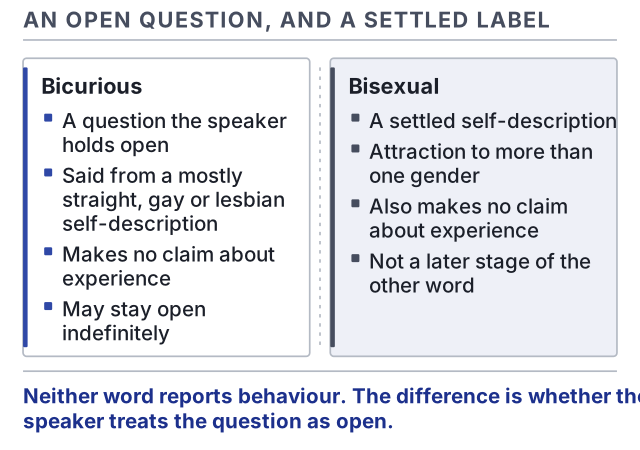
The pair that draws the most searches is bicurious and bisexual. Bisexual is a settled self-description of attraction to more than one gender. Bicurious states an open question about the same ground. Neither stage is a qualification for the other. The neighbouring entries on pansexual and demisexual show how other words in this family divide up the same questions.
What bicurious does not mean
This is the part that keeps the word usable. It is also the part most listicles skip.
It does not mean a trial version of bisexual. The two are different self-descriptions, not a beginner tier and a full one. Someone may, for example, move between them in either direction, or never move at all. The dictionary does not rank which one counts more.
It does not mean a phase everyone passes through. For some people the label describes a period. For others it describes where they are and stay. Treating one of those as the real meaning adds a reading on top of the word.
It does not mean anything has happened. The term reports curiosity. It makes no claim about experience. No amount of experience is required before someone may use it, and none forces them to stop.
It does not mean availability or an invitation. In personals language the word often sat next to signals about what someone was looking for. That closeness still colours how it is read. The definition itself says nothing about who anyone wants to hear from, what they want, or what they consent to.
It does not mean confusion or dishonesty. An open question is not the same as a hidden answer. The word describes a state of not knowing. That differs from the words used for concealment.
It does not mean a diagnosis. It is not a diagnostic category. It is ordinary self-description, and nothing about it calls for assessment, confirmation or explanation of how anyone came to be that way.
Is bicurious a respected label?
The dispute exists, and this entry names it rather than settling it. One position holds that the word is precise and honest. It says exactly as much as the speaker knows, no more. Another position holds that its history in classified advertising left it sounding like a description written for someone else’s benefit. That side prefers questioning or nothing at all.
Both views circulate among people who use these terms daily. The disagreement is about the word’s tone and history. It is not about whether anyone using it is telling the truth. A dictionary can record that without settling it.
Where this page stops
This is a dictionary entry. It defines a word. It does not assess anybody, decide whether a label fits a reader, or advise anyone about disclosure, partners or what to do next.
Some searches behind the word are heavier than vocabulary: distress, pressure from a partner or family, or anything touching safety. That belongs with a licensed professional or a helpline, not with a glossary.
For the wider set of orientation words, see the identity and orientation hub. The full A–Z index of dating terms covers the rest.
Checked: 26 August 2026. Status: rising — the term is being looked up more often than before, and this entry is re-read as that usage settles.