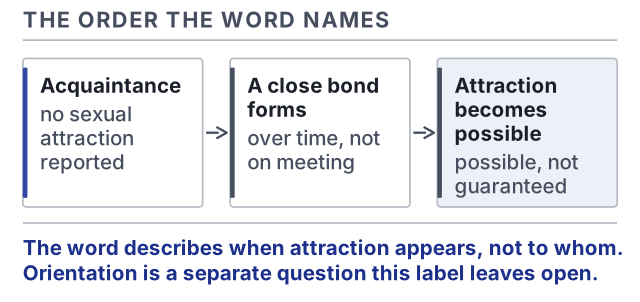
Demisexual is a term for a person who feels sexual attraction only after a strong emotional bond has formed. Toward people they do not know well, that attraction is rare or absent. It is a word people apply to themselves. It sits on the asexual spectrum.
The prefix is the ordinary demi-, meaning half or partial, borrowed from French. Three neighbours share it and nothing else. Demiromantic refers to romantic rather than sexual attraction. Demigirl and demiboy are gender terms.
What does demisexual look like in use?
The word describes the shape and timing of attraction. It says nothing about the strength of a relationship or a person’s morals. Consider three scenes that carry most of the everyday usage.
Someone scrolls a dating app and finds the photo grid blank of signal. Not unappealing. Simply not registering as attraction at all. The same person may feel strong attraction months later, toward a friend whose face was there the whole time.
Someone puts demisexual on a profile as a note about pace. It signals that attraction is likely to arrive late rather than in the first week. The word is giving information, not making a demand.
Someone uses the term looking backward. They read over a decade of relationships and notice that each one began inside a friendship. The label arrives after the pattern, not before it. The term is a description, not a prediction.
Where does the word demisexual come from?
It comes from the online asexual community of the mid-2000s. The source is the forums of the Asexual Visibility and Education Network (AVEN), the main gathering point for those words at the time. Ace Week’s history of the grey-ace words places the coinage there, in a members-questioning thread. It was built from demi- plus -sexual. That is the same pattern as the other spectrum words of the time, such as gray-asexual.
Credit runs to a forum user rather than to a publication. That is usual for community coinages. This entry records the venue and the era rather than a founding text.
Its move into general dating language came later. Dating-app profiles and short video carried it, not any publication. That move is why the word now gets used loosely by people outside the community that coined it. Loose use is where the meaning drifts toward “I like to take my time.” That is not what the term says.
What is demisexual confused with?
Most often with asexual, gray-asexual, demiromantic and sapiosexual. The confusion comes from mixing two questions. Some orientation words answer who attraction points toward. Demisexual answers when it appears. Words from the two groups, such as pansexual and demisexual, are not competing options.
| Term | What the word points at | Key difference from demisexual |
|---|---|---|
| Demisexual | Sexual attraction that appears only after a close emotional bond | — |
| Asexual | Little or no sexual attraction to anyone | Demisexual is a conditional point on that spectrum, not its absence |
| Gray-asexual | Attraction felt rarely, weakly or in unclear circumstances | Broader and vaguer; demisexual names one specific condition |
| Demiromantic | Romantic attraction that appears only after a close bond | Same structure, different kind of attraction |
| Sapiosexual | Attraction reported as driven by intelligence | Names a trait in the other person, not a state of the relationship |
| Pansexual | Attraction not limited by gender | Answers who, not when; the two labels can be held together |
The pair that draws the most searches is demisexual and asexual. Asexual is the wider term, for little or no sexual attraction to anyone. The usual framing is nested, not opposed. The ace spectrum covers attraction that is absent, rare or conditional. Demisexuality names the conditional part. The neighbouring entries on asexual and sapiosexual set out how each word behaves on its own.
What demisexual does not mean
This is the part that keeps the word usable. Most listicles skip it.
It does not mean a rule about sex or a moral position. The term reports when attraction appears. It makes no claim about how long anyone should wait. It holds no argument against casual sex, and no ranking of people who feel attraction differently.
It does not mean a diagnosis or a condition. No clinical manual contains the word. Demisexual is community wording used as self-description. Nothing about it calls for assessment, proof or treatment.
It does not mean low libido. The term is about the direction and trigger of attraction toward others. It is not about sex drive in general. The two are often reported apart from each other.
It does not mean a preference for emotional connection. Enjoying closeness before sex is common. That is not what the word marks. Demisexual describes attraction that does not arrive at all until the bond exists. It is not a preference about order.
It does not mean romance is off the table. Romantic attraction has its own set of words. That is why demiromantic exists at all. A demisexual person may be romantically drawn to strangers in the ordinary way.
It does not mean trauma. The dictionary does not explain why anyone feels attraction the way they do. Causal stories attached to this label, of any kind, are reading added on top of the term. They are not part of it.
Is demisexuality a real orientation?
The dispute exists, and this entry names it rather than settling it. One position holds that demisexuality names a distinct experience. Ordinary orientation labels do not capture it, which is why the ace community coined a word. The other position holds that what the term describes is common enough to need no label of its own.
The disagreement is about categories, not about whether anyone is telling the truth. A dictionary can record that both positions circulate. It cannot rank how true a self-description is, and this one does not try.
Where this page stops
This is a dictionary entry. It defines a word. It does not assess anybody, diagnose anybody, decide whether a label fits a reader, or advise anyone on what to do with a partner.
Some searches carry more than a word question. Distress about attraction, pressure from a partner, or anything touching safety belongs with a licensed professional or a helpline, not with a glossary.
For the wider set of orientation words, see the identity and orientation hub. The full A–Z index of dating terms covers the rest.
Checked: 26 August 2026. Status: current — the term is in steady use in ace-community and dating-app vocabulary, and this entry is re-read as that usage settles.