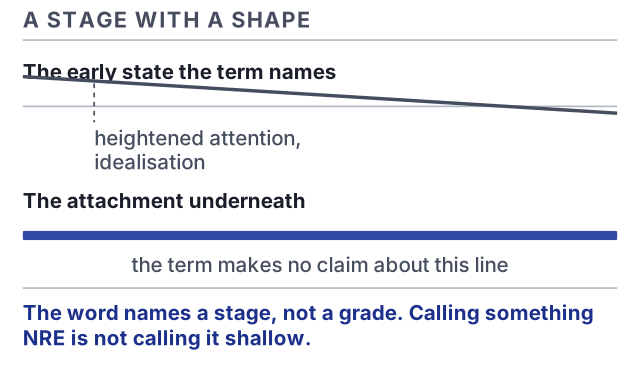
New relationship energy means the giddy, absorbing state of a connection’s early stage. It brings raised attention toward the new person, an idealised view of them, and a rush that reorders ordinary plans. It is almost always shortened to NRE. The word names a phase, not a verdict.
Two things make this entry unusual. The term arrived with a purpose. It was built inside non-monogamous communities, to describe a force that affects more people than the new couple. It has since been borrowed by monogamous speakers, who mostly use it as another name for the honeymoon phase. Watching that borrowing is half of what the word now means.
What does new relationship energy look like in use?
NRE is used about attention and scheduling, not about how good a match is. Consider three scenes that carry most of the usage.
Someone cancels a standing arrangement for the third week running, because the new person is free that evening. Later they describe the stretch as “peak NRE”. That is an explanation offered after the fact, in the words of a passing state.
A partner in an open arrangement says “give it a few weeks, that’s NRE” when a new connection is described in absolute terms. The phrase is doing calming work. It labels the intensity as expected rather than as a threat.
Someone posts that they are “riding the NRE”. They know the phrase will read as self-aware: half celebration, half disclaimer. Used about oneself, the term almost always carries that ironic tilt.
A monogamous speaker uses it flatly, as a fancier honeymoon phase: “we’re four months in, still NRE.” No second relationship is implied. This is the borrowed sense, and it now circulates well outside non-monogamous conversation.
Where does the term NRE come from?
New relationship energy comes out of English-language polyamory communities that organised on Usenet, mailing lists and the early poly web, where the words of non-monogamy were being built in public. It belongs to the same wordstock as terms such as compersion, metamour and polyamory itself.
The coinage is attributed to Zhahai Stewart, in that Usenet-era discussion — an attribution rather than a proof: he later set out the story himself in a retrospective on the term for Loving More magazine, written years after the fact, and no dated first post has been produced here. This entry gives the attribution and no date. The short form still circulates in the non-monogamy writing that grew out of those communities. Jessica Fern’s Polysecure is one widely read example.
The reason for the coinage is easier to trace than the author. Where more than one relationship runs at a time, early-stage euphoria is not a private weather system. It moves evenings, energy and attention that other people were already counting on. A community needed to discuss that without anyone being accused of wrongdoing. It needed a neutral noun. NRE is that noun.
The move into general dating talk came later, carried by relationship podcasts, short video and app-era word lists. The borrowing is partial. General use kept the euphoria and dropped the reason the word existed, which is how loanwords behave.
What is NRE confused with?
NRE is confused most often with the honeymoon phase. After that it is confused with limerence, infatuation and compersion.
| Term | What the word points at | Key difference from NRE |
|---|---|---|
| NRE | Euphoric, absorbing early stage of a connection that has started | — |
| Honeymoon phase | The opening chapter of one couple's relationship | Ordinary English, couple-scoped; carries no implication of other partners |
| Limerence | Involuntary obsessive longing for one person, fed by uncertainty | Can run entirely one-sided, with no relationship at all |
| Infatuation | Short, intense attraction, often to an idealised image | Describes the pull toward someone; NRE describes the state of being in something new |
| Compersion | Pleasure at a partner's happiness with someone else | A feeling about another person's connection, not about one's own |
| ERE | Existing relationship energy — the settled quality of a long bond | Coined as the contrast term, not as a superior state |
The pair that matters most for search is NRE and honeymoon phase. Honeymoon phase is ordinary English for the opening chapter of one couple’s relationship. It hints at no other partners. Register is the practical test. Honeymoon phase is what people say to their families. NRE is what people say to someone who already knows the words. Limerence refers to involuntary obsessive longing for one person, fed by doubt, and it can run wholly one-sided. See the neighbouring entries on limerence and compersion for how each of those words behaves on its own.
What new relationship energy does not mean
It does not mean the relationship is fake. The term describes intensity and its likely fading, not whether the feeling is real. Using it to imply that a new connection is unreal is a move layered on the word, not part of its definition.
It does not mean an excuse. “It was just NRE” explains a state. It does not settle whether an arrangement was kept. The word was coined to open a conversation, not to close one.
It does not mean a diagnosis. NRE is community slang. It has no clinical status, no criteria and no manual entry, and repeating it widely does not give it any.
It does not mean non-monogamy. The word came from those communities, but nothing in current usage requires more than one relationship. Monogamous speakers use it too.
It does not come with a set length. Time spans attached to NRE, for example a few months, a year or two, travel as folklore between forums and videos. This dictionary prints none of them.
It does not mean love. The word describes the temperature of a beginning. Whether anything lasting sits underneath is a separate question. The term does not answer it.
Why does a borrowed word matter here?
Because borrowing changes meaning, and NRE is a clean example. The term was coined for one structural problem: early-stage euphoria reshaping promises to other partners. Speakers with no second partner picked it up. They kept the vivid part and dropped the structural part.
The result is a word with two live senses at once. Inside non-monogamous talk NRE still carries its first load, and “that’s NRE” can be a request to hold agreements steady. Outside it, the phrase is mostly a mood label. Neither use is wrong. A reader who knows only one of them will misread the other.
That double life is also why this entry is marked rising rather than current. Usage is spreading, and spreading usage is where meaning drifts. For the wider set of words that produced the term, see the entries on polyamory and the states and feelings hub.
Where this page stops
This is a dictionary entry. It defines a word. It does not assess anyone’s relationship, predict how any connection will go, or advise anybody on what to do with the feeling.
What sits behind the search may be heavier than vocabulary. It may be distress about a partner’s new connection, an agreement that is not holding, or feelings that are affecting sleep, work or safety. That belongs with a licensed therapist or a helpline in your country, not with a glossary.
Arrived with a different word? Scan the full A–Z index of dating terms.
Checked: 26 August 2026. State: rising — the term is still moving out of non-monogamous vocabulary into general dating talk, and this entry is re-read as that usage settles.