The polyamory meaning is plural by definition: polyamory means having, or being open to having, more than one romantic relationship at the same time. Everyone involved knows about it and agrees to it. The word covers the practice, the orientation people claim, and the relationships themselves.
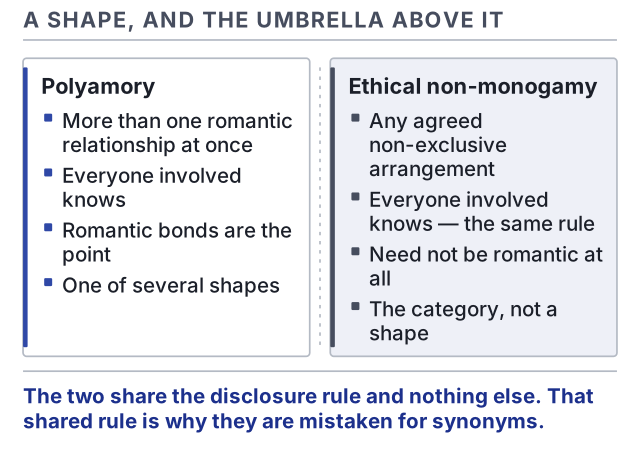
The most useful thing to know is structural. Polyamory is a subset of ethical non-monogamy, not another name for it. ENM is the category. Polyamory is one shape inside it.
What does polyamory look like in use?
In use, the word appears in three ways: as a status marker, as a plain descriptor between people who share the vocabulary, and as a media subject. Consider each of the three settings. The sense shifts a little in each.
On dating apps it is a status marker: “polyam, partnered” or “solo poly, not looking for a primary.” It sits in the same bio line as height and star sign. Here it works as a filter. It tells other users that exclusivity is not on offer.
Between people who already use the vocabulary, the word describes rather than declares. Someone says a partner’s other partner is a metamour. Someone says a household is polyamorous. No explanation follows.
In general media the word is the subject of the sentence rather than a detail in it. The piece is an article about polyamory. That use flattens every non-monogamous arrangement into one word. Most of the confusion in this vocabulary begins there.
Where does the word polyamory come from?
Polyamory is a hybrid coinage. Greek poly (many) is attached to Latin amor (love). Purists complained about the mixed roots early on and lost. That is a normal fate for useful words.
The adjective, and then the noun, spread in the last decade of the twentieth century. It came out of two places. The first was American neopagan writing, where the essay “A Bouquet of Lovers” carried the idea of ethically managed multiple relationships. The second was the early internet, where the Usenet newsgroup alt.polyamory gave the word a community that used it daily. Major English dictionaries added it later, once the usage had settled.
The trade publishing that followed has not stopped. Thornapple Press’s page for Polysecure is one example of that book-length writing on attachment inside non-monogamous arrangements. A dictionary entry cannot give that treatment.
The word has no single inventor with an undisputed claim. No date here is a first attestation. The practice is far older than the label. The label is the recent part.
Is polyamory the same as ENM?
No. The rest of the vocabulary hangs on this distinction. ENM covers any arrangement where more than one connection exists and everyone agrees. Polyamory is the branch where the added connections are romantic relationships, not sexual encounters or one-off permissions.
The practical test is one of shape. For example, a couple who sometimes attend swingers’ events are practising ENM. They would not usually call it polyamory. A person with two long-term partners, who each have partners of their own, is practising polyamory. That is also ENM. The set relationship only runs one way.
So “ENM vs poly” is not a comparison of two rival options. It sets a category against one of its members. That is why answers to the question so often talk past each other.
What is polyamory confused with?
Polyamory is confused most often with open relationships, swinging, throuples, monogamish arrangements and polygamy.
Open relationship refers to a couple who stay the couple and agree to outside contact, most often sexual. The pair is the structure. The outside connections are additions to it. Polyamory does not require a central pair. Where one exists, the vocabulary marks it with words like primary or nesting partner.
Swinging refers to social and recreational activity, built around shared sex between partnered people. Separate romantic attachments do not usually form. Both swinging and polyamory sit under ENM. Neither contains the other.
Throuple. A set shape: three people in one relationship together. A throuple may be polyamorous. But polyamory more often names networks where partners are not all in a relationship with each other.
Monogamish. A largely monogamous couple with narrow agreed exceptions. It is closer to open relationship than to polyamory. The word is defined by how small the exception is.
Polygamy means multiple marriages, usually inside a religious or legal frame, and in history one-directional. It is a different word on a different subject. Polyamory makes no claim about marriage. The shared poly is all the two terms have in common.
What does polyamory not mean?
Polyamory does not mean a lack of commitment, unrestricted sex, an absence of rules, or cheating with permission.
It does not mean a lack of commitment. The word says how many relationships exist, not how serious any of them is. Long cohabitation, children and partnerships of decades all appear inside polyamorous arrangements.
It does not mean sex with anyone available. Polyamory says nothing about how often or how open sexual contact is. It says the romantic relationships are plural and known about. A polyamorous person may be dating fewer people than a monogamous person.
It does not mean an absence of rules. Polyamorous vocabulary is thick with words for making agreements, such as hierarchies, veto, kitchen table and parallel. The arrangements are worked out rather than assumed.
It does not mean cheating with permission. Hiding is what the definition rules out. When someone runs hidden parallel relationships, users of this vocabulary do not reach for this word.
It is not a synonym for compersion, the pleasure a person feels at a partner’s happiness with someone else. Compersion is a common word inside polyamory, not a requirement of it. Its absence rules nobody out of the label.
And it does not mean the opposite of monogamy in any tidy binary sense. Monogamy has its own grey areas: sexual, romantic, social. Several ENM structures sit between the two rather than across a line from one.
Where this page stops
This entry defines a word. It is not guidance on opening a relationship, negotiating one, or picking an arrangement. Nothing here is a recommendation either way. Those questions belong to the people involved, not to a dictionary.
Sometimes what brings a reader to this word is pressure, coercion or a situation they cannot safely leave. The useful next step there is a qualified professional or a helpline, not a longer definition.
More formats and the words that separate them are indexed in Open and non-monogamous.
Checked: 26 August 2026. Usage state: current — polyamory is in standard use in English-language media and dictionaries, and shows no sign of being replaced by a newer coinage.