Enmeshment is a term for a relationship in which the boundary between two people has worn thin. Separate moods, opinions and decisions become hard to tell apart. It is a word about structure — how much separateness a relationship allows. It is applied to families, couples and parent-child bonds alike.
This entry does what a dictionary entry does: meaning, origin, confusions, and the edge of the term. It does not assess anyone’s relationship. It offers no steps for changing one. Where the word points past definition, the last section says so plainly.
What does enmeshment mean?
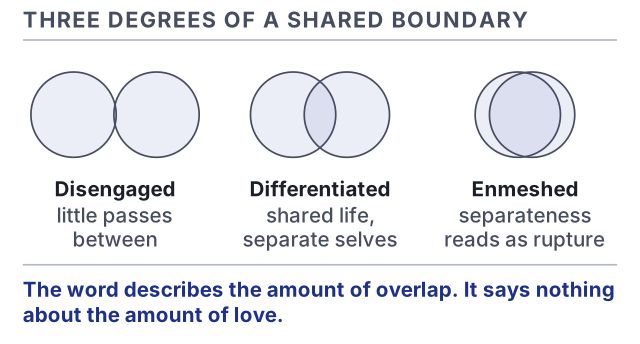
Enmeshment means that the line between two people’s inner lives is unusually thin. One person’s mood is treated as the other’s mood, one person’s plan as the other’s plan. Difference reads as a fault in the relationship rather than a normal feature of it.
The word describes a system, not a trait. In the writing it comes from, nobody “is” enmeshed on their own. Enmeshment is a property of the space between people. That is why the term is normally applied to a family, a pair, or a household rather than to one person. Popular usage has loosened that (people say “I’m enmeshed with my mother”, for example), but the structural sense is the original one. The everyday sense now circulates mostly in popular writing about boundaries and relating. Nedra Glover Tawwab’s Set Boundaries, Find Peace is one widely read example of that genre.
What does enmeshment look like in use?
In use, enmeshment looks like a relationship in which separateness is the exception. It has to be explained. Consider four scenes that show how the word is applied. These scenes show usage. They are not checklists and not signs to measure anyone against.
- The daily-report household. Two adults in a family speak several times a day, and a missed call is treated as something to explain. In writing about family systems, this is the standard case: contact is not the point, the demand is.
- The shared-mood couple. One partner has a bad day and the other’s day is bad too. Writers use the word here when the sharing is not chosen but assumed. A mood spreads because there is no boundary for it to stop at.
- The confidant child. A parent tells an adult child things usually kept between partners or friends. This is the scene behind the popular phrase mother-son enmeshment. The same phrasing appears for mothers and daughters, fathers and sons.
- The unpopular opinion. Someone in the family prefers something different — a city, a career, a partner — and the disagreement is handled as disloyalty rather than as taste. Writers reach for the word when difference itself, not the choice, is the crisis.
Where does the word “enmeshment” come from?
Enmeshment entered relationship vocabulary through structural family therapy. That is the school linked to Salvador Minuchin, whose Families and Family Therapy reached a wide professional audience in the 1970s. There, enmeshment and disengagement named the two ends of a range: families where boundaries are too permeable, and families where they are too rigid.
The route into everyday dating language is the ordinary one for therapy words. It runs from clinical writing into self-help publishing, then into social media captions. There it lost most of its structural sense and became a label people apply to one person. The timing of that popular spread is not documented in any source this glossary can name, so it is left unstated rather than guessed.
One point of order about the plain English word. Enmeshed has an ordinary meaning (tangled in a net) that predates the therapy sense by centuries. The relationship term borrows the image, not the old usage.
What is enmeshment confused with?
Enmeshment is confused most often with codependency. After that it is confused with closeness, attachment style and the words for controlling behaviour.
| Term | What it names | How it differs from enmeshment |
|---|---|---|
| Enmeshment | A boundary structure: how little separateness a relationship allows | — |
| Codependency | A role: organising one's life around managing another person's behaviour | Describes what someone does; enmeshment describes the shape of the boundary |
| Closeness | How much two people share by choice | Says nothing about whether difference is tolerated, which is the enmeshment question |
| Attachment style | A pattern of relating, described in attachment research | A description of an individual's pattern; enmeshment is a description of a system |
| Controlling behaviour | Deliberate restriction of another person's choices | Names intent and conduct; enmeshment names structure and implies no intent at all |
The most frequent mix-up is with codependency. Both words get used for relationships that feel too tightly wound. But they answer different questions. Codependency is a term from addiction literature for a role someone occupies. Enmeshment is about how much room the relationship leaves for two separate people. A relationship can be described with one word, both, or neither. The dictionary entry for codependency covers that term’s own origin.
The second confusion is with limerence. Limerence refers to an intense, involuntary preoccupation with one person. It is a state inside one head, usually early and usually about someone who is not yet a partner. Enmeshment describes a settled arrangement between people, often years old. See limerence for that distinction in full.
The third is with vocabulary for controlling behaviour. Those words carry a claim about intent. This one does not, which is why swapping them is a real error.
What does enmeshment NOT mean?
Enmeshment does not mean a close family, an abusive one, or a diagnosis attached to any person. Here is the boundary of the term, the part most listicles skip:
- It does not mean a close family. Plain markers of closeness, such as frequent contact, shared holidays and strong loyalty, are not what the word points at. The term asks what happens when someone wants something different.
- It does not mean abuse. The word carries no claim about intent or harm. Family therapy writing applies it to warm families as readily as to hostile ones.
- It is not a diagnosis. In therapy writing, enmeshment describes a structure. It is not a condition a person can be found to have.
- It is not a property of one person. “He is enmeshed” is shorthand. The term describes what happens between people, which is why it survives being applied to whole families.
- It is not the same as being a caring child, partner or parent. Care is a motive. Enmeshment is a shape. Motives are not what the word measures.
- It does not mean the relationship must end. Nothing about the term implies an outcome or a prescription. That reading is imported by the internet, not by the source literature.
Where this page stops
This entry defines a word. It cannot tell any reader whether the word fits their family or their relationship. It offers no method for changing one. Assessment and change are the work of a qualified professional — a therapist, counsellor or family practitioner — who can hear the specifics.
If reading about this raises something urgent, or if any relationship in your life feels unsafe rather than simply close, contact a licensed professional or a helpline in your country. A glossary is the wrong instrument for that. Pretending otherwise would be the more harmful choice.
Related entries
Enmeshment sits in the states and feelings hub alongside the other words this glossary keeps for inner and relational states. The full list of terms lives in the A–Z index. It includes definition-only entries for words covered in depth elsewhere.
Entry checked: 26 August 2026. Usage: current — the term is in steady use in both therapeutic and popular writing, with the popular sense drifting toward individual labels.