What does compersion mean?
Compersion is the pleasure or warmth a person feels when a partner is happy with someone else, usually in a romantic or sexual connection. It names a good response to a situation that English otherwise has only a bad word for: jealousy.
The word is a noun and takes no article in normal use. People say I felt compersion, not a compersion. There is no common verb form. The adjective compersive appears, but it is rare. It still reads as community shorthand rather than standard English.
Unlike most terms in this hub, compersion has no everyday synonym. That gap is the point of the coinage. The vocabulary had a word for the pain and none for the pleasure. Speakers who needed the second one made it.
What does compersion look like in use?
Consider these illustrations of how the word appears, not descriptions of how anyone should feel.
- Someone tells a friend about a partner coming home cheerful from a date with another person. They were surprised by how pleased they were. They call that reaction compersion.
- A forum post asks whether it is normal to feel compersion about one partner and unease about another. The word is treated as one feeling among several.
- A writer on non-monogamy uses compersion as a heading. It sits beside jealousy, as the two reactions readers ask about most.
- A monogamous reader borrows the term for pleasure at a partner’s success at work. That is a looser stretch of the first sense. It is not how the community that coined it uses the word.
Where does the word compersion come from?
Compersion began in American non-monogamous communities in the second half of the twentieth century. It is usually credited to the Kerista commune, a communal group in San Francisco. That group made a small vocabulary of its own for group relationships. The word spread from there through polyamory writing, mailing lists and, later, forums.
The exact coining moment is not documented well enough to name a year, so this entry does not name one. The setting is established. It is a community coinage, not a clinical or academic term, and not a translation of an older English word.
Two older words are often named alongside it. Mudita refers to sympathetic joy in general. It reaches English from Buddhist teaching in Sanskrit and Pali. The German Mitfreude means shared joy, the literal counterpart to Schadenfreude. Neither is a source of the English word. Both are cited as proof that the idea existed before the coinage did.
What is compersion confused with?
| Term | What it names | How it differs from compersion |
|---|---|---|
| Compersion | A feeling: pleasure at a partner's happiness with someone else | — |
| Jealousy | A feeling: distress or threat about a partner's connection elsewhere | Usually framed as the contrast term, not a structural opposite |
| Polyamory | A relationship structure with more than one romantic partner | A structure, not a feeling; compersion is not required to be in one |
| ENM | An umbrella for agreed non-monogamous arrangements | Also a structure; compersion is one thing people report inside it |
| Mudita | Sympathetic joy in Buddhist vocabulary, at anyone's good fortune | Broader and older; not restricted to partners or romance |
| NRE | The intense early-stage excitement of a new connection | Felt about one's own new connection; compersion is about someone else's |
The most common mix-up is treating compersion as a synonym for a relationship style. It is not one. For example, a person in an open or non-monogamous arrangement may report compersion, may not, or may report it unevenly. The structure keeps its name either way. The structural words are set out in the entries for ENM and polyamory.
Jealousy is the distress or sense of threat a person feels about a partner’s connection elsewhere. It is the word compersion is usually set against.
The second mix-up runs the other way. NRE refers to the sharp early excitement of a new connection, felt by the person inside it. Compersion and NRE are both good feelings around new connections. But they sit on opposite sides of it. NRE belongs to the person in the new relationship. Compersion belongs to someone watching a partner have one.
Is compersion the opposite of jealousy?
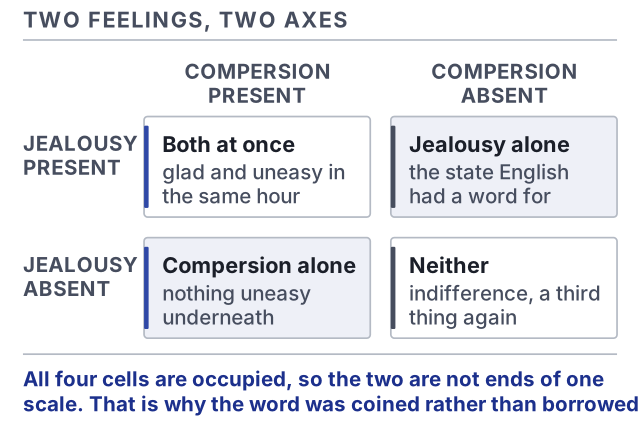
It is the word usually offered as the opposite of jealousy. That framing comes from the communities that coined it, not from emotion research. The pairing is a rhetorical contrast, not a technical antonym.
Two things follow. Compersion and jealousy are not two ends of one dial. Speakers describe both about the same evening — a partner’s date night, for instance. And the absence of compersion is not jealousy. It is often just neutrality, which has no special name in this vocabulary.
What does compersion not mean?
Compersion does not mean approval of non-monogamy, the absence of jealousy, an obligation, a technique or a personality trait. This is the boundary of the term. It is the part most listicles skip.
- It does not mean approval of non-monogamy. The word names a feeling. Someone can define it, or feel it, without holding any position on relationship structures.
- It does not mean the absence of jealousy. Compersion is not a cleared state or a level reached. It sits beside other feelings, and it comes and goes.
- It does not mean an obligation. In community usage compersion is reported, not required. Reading it as a standard partners owe each other misuses a descriptive word.
- It is not a technique or a practice. No procedure is attached to the noun. Entries that turn it into steps have moved from defining a word to giving advice.
- It is not a diagnosis or a trait. Nobody is or is not “a compersion person.” The word describes an episode of feeling, not a personality type.
- It is not consent. Feeling glad about a partner’s other connection is one thing. Any agreement about what is open in a relationship is another. Different words describe the agreement.
The longer treatment sits in books rather than glossaries. Polysecure, published by Thornapple Press is one such book on attachment inside non-monogamous arrangements.
Where this page stops
This entry defines a word. It does not assess anyone’s relationship. It takes no view on whether an arrangement suits the people in it. A reader may want help with what they are feeling. An arrangement may involve pressure, fear or coercion rather than agreement. Both belong with a licensed therapist or counsellor, or with a helpline. A dictionary is the wrong tool for it.
Related entries live in the open and non-monogamous hub. Every term on this site is listed in the A–Z index.
Checked: 26 August 2026. Compersion is in current use in non-monogamy writing and is stable in meaning; this entry is re-checked as the vocabulary around it shifts.