Codependency meaning is simple to state. It is a relational role. One person organises their life, mood and sense of worth around managing another person’s behaviour or needs. The word began as a technical term in addiction writing. It has since widened into everyday relationship talk, and it now covers far more ground than it once did.
This entry is a dictionary entry. It defines the word and traces where it came from. It separates the word from the terms it gets swapped with, and marks its edge. It does not assess any reader’s relationship. It carries no steps for leaving one.
What does codependency mean?
Codependency means that one person in a relationship has taken on the job of managing another — their drinking, their moods, their crises, their approval. Their own needs and judgement stop being part of the arrangement.
Two things sit inside the definition. The first is asymmetry: the word is used for lopsided caretaking, not for mutual reliance. The second is substitution. The caretaking has taken the place of the person’s own life rather than sitting alongside it. Strip either part out and the word stops fitting. For example, “we’re so codependent, we text all day” is a joke rather than a use of the term.
In its everyday form, the word is a self-description far more often than a label handed to someone by a professional. That matters for how much weight it can carry.
What does a codependent relationship look like?
A codependent relationship, as the word is used, looks lopsided. One person does most of the giving way, and the other’s state sets the terms. Consider three scenes that show how the word is applied. These scenes show usage. They are not signs to measure a relationship against.
- The consequence-catcher. One partner handles what the other’s choices produced, again and again: the missed shift explained to a boss, the overdraft covered, the apology made to a friend. Writers reach for the term when this becomes the shape of the relationship rather than a one-off favour.
- The weather-watcher. Someone plans a whole evening around reading another person’s mood on arrival. The early writing uses this scene often. It shows the caretaker’s day being set by someone else’s state.
- The vanished preference. Asked what they want to do, one person cannot say without first working out what the other wants. In popular usage this is the short version of the whole idea: a self that has become an accessory to someone else’s.
Where does the word “codependency” come from?
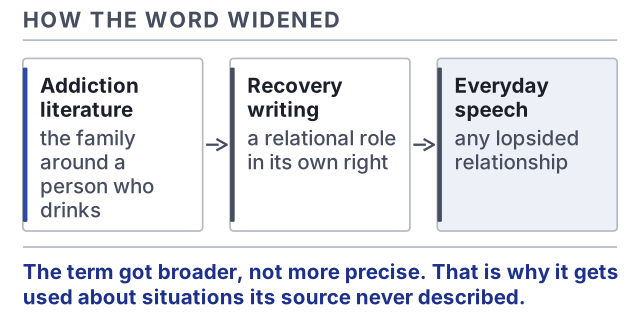
Codependency comes out of the alcoholism-treatment world of the 1970s. Clinicians and mutual-help groups there already had terms such as co-alcoholic for the spouse or family member of a person who drank. “Co-dependent” widened that. The prefix marks the second person in the dependency, the one whose life had reshaped itself around it.
The move into general use came through 1980s self-help publishing. The book most often credited with it is Melody Beattie’s Codependent No More. It put the word on bestseller lists, and it applied the word well past households affected by alcohol. From there the term entered talk shows, magazine columns and, in the end, dating captions.
That widening is the whole story of the term. It is a familiar story for words borrowed from clinical writing: each step outward buys reach and spends precision. By the time the word reached short-video captions, it was used for any relationship that felt too sticky. The exact timing of that last stage is not documented in any source this glossary can name, so it is left unstated rather than guessed. The everyday sense now sits beside a large popular literature on boundaries and relating. Nedra Glover Tawwab’s Set Boundaries, Find Peace is one widely circulated example.
One more thing belongs with the origin. The term has been contested since the 1980s. Critics inside the therapy world argued it was too elastic to mean much. They also argued it risked recasting ordinary care — much of it done by women — as pathology. That argument was never settled, and this entry does not settle it either.
What is codependency confused with?
Codependency is confused most often with enmeshment. After that it is confused with limerence, and with the words for controlling or abusive behaviour.
| Term | What it names | How it differs from codependency |
|---|---|---|
| Codependency | A role: organising one's life around managing another person | — |
| Enmeshment | A boundary structure: how little separateness a relationship allows | Describes the shape of the boundary, not who is doing the caretaking |
| Interdependence | Mutual reliance with both people's needs stated | Symmetrical by definition; codependency is used for lopsided arrangements |
| Anxious attachment | An individual pattern described in attachment research | A description of one person's style; codependency describes a role inside a pair |
| Caregiving | Practical care for someone who needs it, often by necessity | Names a task and a circumstance; implies nothing about a vanished self |
The closest neighbour is enmeshment, and the two are routinely used as synonyms. They are not. Enmeshment is a family-therapy term for how much separateness a relationship tolerates. Codependency asks what role a person has taken inside it. A couple can be described by one word, both, or neither. See the enmeshment entry for that term’s own origin and limits.
The second confusion is with limerence. Limerence refers to an involuntary preoccupation with one person, usually early and often unreturned. Limerence is a state inside one head. Codependency is a pattern of conduct inside a settled relationship. The limerence entry keeps that distinction.
The third is with the words for controlling or abusive behaviour. Those words make a claim about what one person does to another. Codependency, as written, describes what someone does to their own life in answer to another. Swapping the words blurs both. The harder subject belongs to writing built for it, not to a glossary.
What does codependency NOT mean?
Codependency does not mean caring a lot, needing other people, or being on the receiving end of abuse. It names only the lopsided role described above. Here is the edge of the term, the part most listicles skip:
- It is not a diagnosis. Codependency has never been a disorder in the standard diagnostic manuals. It is a descriptive term from recovery and self-help writing. No one can be “found to have” it the way a condition is found.
- It does not mean loving someone a lot. Intensity is not the measure. The word points at whether a person’s own needs and judgement are still present in the arrangement.
- It does not mean needing people. Plain reliance — practical, emotional, financial — is not what the term names. Treating every need as codependency empties the word.
- It does not mean caring for someone who is ill or dependent. Caregiving under real need is a circumstance, not a role someone chose to disappear into.
- It does not name abuse. The term carries no claim about the other person’s intent or conduct. Borrowing it for coercion misdescribes both things.
- It is not a personality type. Popular usage says “I’m codependent” as if it were a fixed trait. The word came from describing a position inside one relationship.
- It does not imply an outcome. Nothing in the term says a relationship should end. That reading is imported by the internet, not by the literature the word came from.
Where this page stops
This entry defines a word. It cannot tell any reader whether the word fits their relationship. It contains no method for changing one. Assessment and change are the work of a qualified professional — a therapist, counsellor or addiction practitioner — who can hear the specifics.
If reading this raises something urgent, or if a relationship in your life feels unsafe rather than simply lopsided, contact a licensed professional or a helpline in your country. A glossary is the wrong instrument for that. Pretending otherwise would be the more harmful choice.
Related entries
Codependency sits in the states and feelings hub with the other words this glossary keeps for inner and relational states. The full list lives in the A–Z index. It includes short definition entries for terms covered in depth elsewhere.
Entry checked: 26 August 2026. Usage: current — steady in both recovery-adjacent and popular writing, with the popular sense continuing to widen past its original subject.