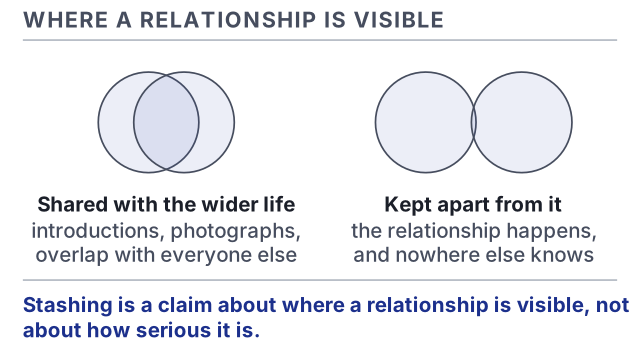
Stashing is dating slang for keeping the person you are seeing hidden from the rest of your life. No introductions to friends or family, no presence on your public accounts, no overlap with your wider world. It is a word about the visibility of a relationship.
Not to be confused with the ordinary English verb. A stash is a hidden supply of something: cash, snacks, contraband. In general usage, stashing means putting an object away for later. The dating term borrows that image and applies it to a person. That is why it stings in use.
This entry is a dictionary entry: meaning, origin, confusions, and where the term stops. It does not assess anyone’s relationship and does not offer a course of action.
What does stashing mean?
Stashing means that a relationship is real but structurally invisible. The two people involved know it exists; nobody else in either life has been given a reason to.
The word points at a gap between how much of a life two people share privately and how much they share in public. It is applied when that gap looks kept up rather than accidental. The split between the relationship and everything else appears to be the arrangement itself, not a stage before an announcement.
One structural note matters for using the term correctly. Stashing describes an asymmetry. In ordinary usage, one person does the stashing and the other is stashed. When both people keep a relationship private by agreement, commentators reach for other words: private, discreet, not public yet.
What does stashing look like in use?
In use, stashing is applied when a relationship that is clearly established leaves no trace anywhere else in one person’s life. Consider three scenes that show how the word is used. These are illustrations of usage, not signs to measure a relationship against.
- The empty group chat. Months of regular meetings, dinners, weekends — and none of the other person’s friends know a name. Plans are always for two, and always somewhere the rest of their life is not.
- The absent account. Public posts continue as normal: holidays, a birthday, a dog. The relationship appears in none of them, not even cropped or unlabelled. This is the scene writers most often use when contrasting the word with a soft launch.
- The unexplained separation of worlds. A family event, a colleague’s wedding, a housewarming: at each one a partner would normally appear. The question of going never comes up. Commentators apply the word when this becomes the pattern rather than the exception.
Where does the word “stashing” come from?
The dating sense is credited to the journalist Ellen Scott, writing in the UK paper Metro. That attribution is set out in Dictionary.com’s slang entry for stashing. The Metro column itself is the record everything else points back to.
From there the lifestyle press picked it up in the late 2010s, alongside the wave of dating coinages that dating-app blogs carried with it. The same pattern carried a long list of gerund terms into general use, one explainer at a time. Later write-ups largely cite each other rather than the original.
The underlying verb is much older and entirely ordinary. Stash, meaning a hidden store, was in English long before anyone applied it to a partner. The dating sense is a metaphor placed on top, not a new word.
What is stashing confused with?
Stashing is confused most often with pocketing, a soft launch and cushioning. The table below sets out where each one differs.
| Term | What it names | How it differs from stashing |
|---|---|---|
| Stashing | Keeping an existing relationship hidden from one's wider life | — |
| Pocketing | The same pattern, different label | Treated as a synonym in most dating writing |
| Soft launch | Posting about a partner while withholding identifying details | The audience knows a relationship exists; stashing hides that it exists at all |
| Cushioning | Maintaining backup connections alongside a main one | Describes who else is in the picture, not who is allowed to see the picture |
| Breadcrumbing | Intermittent contact that keeps interest alive without progressing | About the frequency and content of contact, not about visibility |
| Benching | Holding someone in reserve while pursuing others | Concerns priority and pace; stashing concerns exposure |
Pocketing is the closest neighbour, and most writers treat it as an outright synonym. Some writers try to draw a line between them, for example pocketing for friends and stashing for family. Those splits appear in single articles and are not consistent across sources. This glossary therefore records them as the same term with two labels.
Soft launch is the most useful contrast. The term is covered in depth elsewhere and defined here only for comparison. It is an act of publication: a sleeve, a second coffee cup, a hand. Stashing is the absence of publication. One withholds identity, the other withholds existence. Confusing them turns an ordinary bit of privacy into an accusation.
Two sibling entries in this hub sit close by. Cushioning is about keeping other options. Breadcrumbing is about the rhythm of contact. A relationship can be described with any of these words, all of them, or none. They answer different questions. Benching, another neighbour, is defined in the table above and expanded on other sites, not here.
What does stashing NOT mean?
Stashing does not mean early privacy, staying off social media, or cheating. The edge of the term is the part most listicles skip:
- It does not mean a new relationship that has not been announced. Early privacy is not what the word points at. Usage requires an established connection and a standing pattern.
- It does not mean staying off social media. People who post nothing about anything are not stashing anyone. The word depends on a contrast: a visible life with a specific omission in it.
- It does not mean cheating. Concealment and infidelity are different claims. Someone may be hidden for reasons that have nothing to do with another partner. The term itself names no reason at all.
- It does not carry a motive. The word is silent on reasons such as fear of family reaction, a private falling-out, an employer, an immigration situation, or plain indifference. Writing that treats stashing as proof of intent is adding something the term does not have.
- It is not a personality type. “He’s a stasher” is shorthand. The term describes a pattern in one relationship, not a fixed trait. The same person may be fully public about another.
- It is not the ordinary English verb. Stash means to conceal or hide something, a sense recorded in 18th-century criminal slang, as Etymonline’s entry for stash sets out. The dating word is a metaphor built on that.
- It is not a diagnosis and not a verdict. Stashing is descriptive vocabulary. It does not establish that a relationship is harmful, nor that it is fine.
Where this page stops
This entry defines a word. It cannot tell any reader whether the word fits their situation. It offers no script, no timeline and no advice about what to do next. Those belong to the people in the relationship. Where the question is heavier than vocabulary, they belong to a qualified professional who can hear the specifics.
If reading about this raises something urgent, contact a licensed professional or a helpline. The same holds if being kept out of sight is part of a situation that feels unsafe rather than simply frustrating. A glossary is the wrong instrument for that.
Related entries
Stashing sits in the app-era behaviour hub. That hub holds the other words this glossary keeps for patterns that took their current shape on dating apps. The full alphabetical list of terms, including definition-only entries, lives in the A–Z index.
Entry checked: 26 August 2026. Usage: current — the term is in steady use in dating journalism and short-video vocabulary, most often alongside its synonym pocketing.