Monkey barring is dating slang for leaving one relationship only once the next partner is already lined up. The hand grips the new bar before the old one is released. It names a sequence of timing, not a personality.
Not to be confused with the literal sense, which is much older and far more common. Monkey barring is what children do on the playground frame. Searching the bare phrase will mostly return equipment, safety guidance and school photographs. The relationship sense is a metaphor built on top of that picture. The variant spelling monkey branching swaps the frame for a tree and means the same thing.
This is a dictionary entry: meaning, origin, confusions, and the edge of the word. It does not evaluate anyone’s relationship and offers no steps.
What does monkey barring mean?
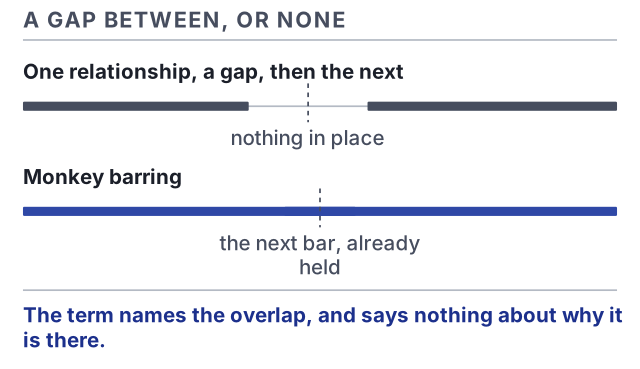
Monkey barring means ending a relationship at a point where a replacement attachment already exists. The overlap is the whole content of the term. Remove the overlap and the word does not apply. An ordinary breakup followed later by a new partner is not what the phrase describes.
Two things sit inside the definition. First, order: the new connection begins, or is at least secured, before the old one formally ends. Second, continuity: there is no gap. Popular usage often adds a third element, calculation: the idea that the person planned it. That is a guess about a mind, not part of what the words say.
The verb travels in several forms, for example to monkey bar, monkey barring out of a relationship, and being monkey branched.
What does monkey barring look like in use?
In use, monkey barring is applied to an ending that visibly overlaps with a beginning. Consider the scenes below, which show where the label gets applied. These are illustrations of vocabulary, not signs to measure anyone against.
- The overlapping announcement. A breakup becomes public. A new relationship becomes public soon after, in a way that suggests the second began before the first ended. Commenters reach for the term because of the timing, not because they know anything else.
- The friend who was always around. Someone ends a long relationship and is with a person who had been a constant presence for months. The word is used after the fact, once the sequence is visible in hindsight.
- The bar-to-bar reading of a pattern. The label is sometimes applied to a whole dating history rather than one exit: a series of relationships with no gap between them. This is the loosest use of the phrase and the one furthest from a definition.
- The literal one. In a parenting article or a playground listing, monkey barring is a child crossing a set of rungs. The two senses almost never appear in the same context. The confusion happens through search results rather than in conversation.
Where does the word “monkey barring” come from?
The word comes from the playground. On monkey bars, moving forward means holding the next rung before letting go of the last. Applied to relationships, the image describes crossing without ever hanging free.
Who first used it that way is not established. No source this glossary can name identifies a coiner, a first printed use or a founding post. What can be described is the route. It ran through online relationship forums and community definition sites, then advice writing, then short-form video, broadly across the 2010s. That timeline is rough and repeated rather than documented, the usual condition for app-era coinages.
Monkey branching is the variant spelling, and it carries an extra layer. It travels attached to a folk saying about swinging from branch to branch, usually aimed at women. The saying is sometimes dressed up as a claim about how people behave. Those claims circulate as folklore, not as findings. This glossary has no approved figures on the subject and does not repeat the numbers that float around with the phrase. The gendered framing is part of why the word is contested. Naming the dispute is as far as a dictionary entry goes.
What is monkey barring confused with?
Monkey barring is confused most often with cushioning, a rebound and its own variant spelling monkey branching. The table below sets out where each one differs.
| Term | What it names | How it differs from monkey barring |
|---|---|---|
| Monkey barring | Leaving a relationship into a new one that was secured first, with no gap | — |
| Monkey branching | The same overlap-then-exit sequence, tree image instead of a frame | A spelling variant, not a different meaning; carries more gendered folklore |
| Cushioning | Keeping backup prospects in reserve while attached, with no exit in view | A standing arrangement; monkey barring requires an exit that happens |
| Micro-cheating | Small ambiguous acts read as crossing a line inside a relationship | About individual acts; monkey barring is about the timing of an ending |
| Rebound | A new relationship starting soon after an ending | The gap is after the breakup; in monkey barring the overlap comes before it |
Cushioning is the closest neighbour and the most frequent swap. It names people held in reserve while a relationship continues. Nothing has to end for the word to apply. Monkey barring needs an actual transition. See cushioning for that term in full.
Rebound is the mirror image. Both describe a short gap between partners. The rebound sits after the ending. The whole point of monkey barring is that the next attachment starts before it.
Micro-cheating overlaps in tone and not in substance. It labels small acts within a relationship rather than the shape of its ending. Micro-cheating is its own entry. Words that describe someone being kept out of a partner’s public life, such as stashing, are unrelated. They concern visibility, not exits.
What does monkey barring NOT mean?
Monkey barring does not mean cheating, a proven motive, or a rebound. The boundary of the term is the part most trend lists skip:
- It does not mean cheating. Cheating is a broken agreement between particular people. Monkey barring describes timing. The two can overlap. Neither implies the other.
- It does not name a motive. The definition covers the sequence. Whether anyone planned it, drifted into it, or ended one relationship because another had already begun is a question about a person. Slang cannot settle it.
- It is not a diagnosis or a personality type. Monkey brancher is a label used in argument, not a category anyone can be assessed as belonging to.
- It does not mean the new relationship is doomed. The phrase describes an origin, not an outcome. Predictions about outcomes are not part of the meaning.
- It is not the same as a rebound. The order of events is different, and the order is the definition.
- It does not describe one gender. Common usage skews that way. The words do not.
- It is not the playground sense. In every context outside relationship talk, monkey barring is a child crossing a set of rungs.
Where this page stops
This entry defines a word. It cannot say whether the word fits a specific relationship. It holds no scripts, steps or verdicts. Those belong to advice writing about situations this page knows nothing about.
If reading this touches something heavier than a confusing timeline, take it elsewhere. For a relationship that feels unsafe rather than merely unclear, or the aftermath of one, a licensed professional or a helpline is the right place. A glossary is the wrong instrument, and pretending otherwise would be the more harmful choice.
Related entries
Monkey barring sits in the app-era behaviour hub. That hub holds the other words this glossary keeps for how relationships start, stall and end on and around dating platforms. Every term, including short definition-only lines, is listed in the A–Z index.
Entry checked: 26 August 2026. Usage: current — steady in general dating writing, with monkey branching the more common form in community and video use.