Micro cheating is a popular term for small acts of attention directed at someone outside a relationship: a private message, a kept-warm flirtation, an unmentioned lunch. Such acts stop short of a physical or emotional affair. A partner still reads them as disloyal.
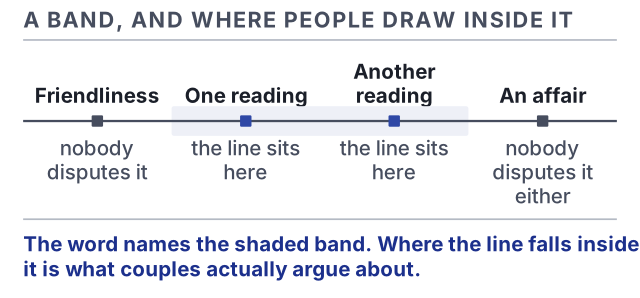
The word is contested, and this entry says so up front. No agreed threshold for what counts exists. The argument about where the line sits is part of the term’s meaning, not a flaw in it. What follows is a dictionary entry: meaning, usage, origin, confusions, and the edge of the word.
What does micro cheating mean?
Micro cheating means behaviour that a partner reads as a breach of exclusivity. The act still falls below what either person would call an affair. The prefix does the work. It claims the act is small in scale but the same in kind as infidelity.
Two features run through the way the word is written about. The first is concealment: the act is minor, but it goes unmentioned. The second is availability. The behaviour signals to someone outside the relationship that the door is not fully closed. Both recur in how the word is applied; neither depends on the act itself being remarkable.
What does micro cheating look like in use?
In use, micro cheating is applied to small, usually unmentioned attention aimed at someone outside the relationship. Consider four scenes that show how people deploy the word. These are illustrations of usage, not signs to measure a relationship against.
- The kept app. A dating profile stays installed and gets opened now and then after a relationship becomes exclusive. Nothing is arranged. Commentators reach for the term because the account reads as a door left ajar.
- The unmentioned lunch. Someone has a plain, ordinary meal with a colleague. They do not mention it at home. The word is applied to the omission, not to the lunch.
- The attentive follower. Steady private replies to one person’s stories, late at night, framed as banter. Nothing said would be out of place in public. The pattern is what gets named.
- The maintained ex. Irregular check-in messages with a former partner, kept off the shared conversation. Writers use the term here almost by reflex. This is also where the objection to the term is loudest.
Where does the term “micro cheating” come from?
The phrase entered general circulation through the relationship-advice press of the late 2010s. It surfaced first in Australian coverage quoting the dating expert Melanie Schilling. The piece that carried it is HuffPost Australia’s explainer on micro-cheating. British and American outlets then reprinted the framing. A single first coinage is not established. This glossary does not guess at one.
The construction itself is a productive pattern rather than a one-off. Micro- had already been attached to social behaviour elsewhere in the language. Dating vocabulary then borrowed the prefix whole. It promises that something familiar is being seen at a smaller scale. That is also the source of the objection covered below: a prefix is not a definition.
Short-video platforms later carried the term into everyday speech, largely through example-listing content. That format explains why the word arrives attached to a number, for example ten signs or twenty-one examples. Those lists are editorial folklore, invented for the headline and inconsistent between publications.
What is micro cheating confused with?
Micro cheating is confused most often with emotional cheating, soft cheating and ordinary flirting. The table below sets out where each one differs.
| Term | What it names | How it differs from micro cheating |
|---|---|---|
| Micro cheating | Small, usually concealed acts of outside attention read as a breach | — |
| Emotional cheating | A sustained redirection of intimacy and confiding to someone else | Describes depth and duration; micro cheating describes scale and concealment |
| Soft cheating | Informal synonym in popular usage | Same territory, different word; neither has an agreed threshold |
| Flirting | Playful signalling, often with no claim about a relationship at all | Carries no accusation; micro cheating adds the claim that a boundary was crossed |
| Breadcrumbing | Intermittent attention that keeps someone hopeful without progressing | Names what is done to the outside person, not what is owed to a partner |
Emotional cheating is the sharpest confusion. That term names a bond: sustained intimacy, confiding and priority given to someone outside the relationship. Micro cheating names an act or a habit. Its weight comes from framing rather than from depth. Popular writing often treats the second as an early form of the first. That is a claim about sequence, not a definition.
Soft cheating is the same territory under a different word. Popular writing swaps the two freely. Neither phrase has an agreed threshold.
Breadcrumbing is the second confusion. It sits in the same app-era vocabulary but points the other way: at the person being strung along, not at the partner kept in the dark. The entry for breadcrumbing sets out that term on its own. A third neighbour is cushioning, which names keeping a backup option warm. Micro cheating makes no claim about motive or backup plans, only about the act as read.
The dispute inside the word
Two readings compete. This glossary reports both rather than choosing.
Reading one: small breaches are still breaches. On this account the term fills a real gap in the language. Exclusivity is made of many small understandings. No word covered breaking them below the level of an affair. Concealment is treated as the tell. If it would not be said out loud at home, it belongs under the term.
Reading two: the word stretches infidelity too far. Critics argue that the prefix smuggles in an accusation. Ordinary friendliness and privacy get recast as low-grade betrayal. Lists of “signs” hand people a vocabulary for watching a partner. On this reading the term describes the accuser’s threshold rather than the accused’s act.
Both readings are in active use. That is why two people can use the phrase correctly and mean opposite things by it.
What does micro cheating NOT mean?
Micro cheating does not mean infidelity, a fixed set of behaviours, or a verdict about anyone. The boundary of the term is the part the listicles skip:
- It does not name a fixed set of behaviours. No agreed list exists, and numbered ones are magazine convention.
- It is not a verdict. The word records that someone read an act as a breach; it does not establish that a breach occurred.
- It does not mean infidelity in the ordinary sense. The whole point of the prefix is that the act falls below that line.
- It says nothing about intent. The term is applied to the act as seen, not to what the person meant by it.
- It is not a clinical or legal category. It is popular vocabulary, dated to the late 2010s, with no standing beyond that.
- It does not describe a type of person. The term describes behaviour in a relationship, not anyone’s character.
Where this page stops
This entry defines a word. It cannot tell any reader whether the word applies to their partner, their relationship or themselves. It offers no method for handling it either. That conversation belongs to the two people involved. Where it needs help, it belongs to a qualified professional such as a couples counsellor or therapist.
If reading about this raises something urgent, contact a licensed professional or a helpline. The same holds if a relationship feels unsafe rather than merely uncertain. A glossary is the wrong instrument for that.
Related entries
Micro cheating sits in the app-era behaviour hub. That hub holds the other words this glossary keeps for how people act inside dating apps and group chats. Every term the site covers, including definition-only entries, is listed in the A–Z index.
Entry checked: 26 August 2026. Usage: current — in steady popular use, with its boundary openly disputed.