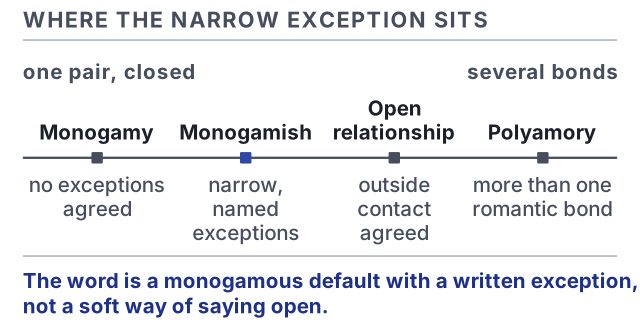
Monogamish refers to a couple who treat monogamy as the default state of their relationship, but who have agreed on narrow, named exceptions. The exception is most often occasional sexual contact with other people. The main partnership is understood to be unchanged by it.
The word is a blend of monogamous and the softening suffix -ish. The suffix carries the whole meaning. It is not a synonym for open. Its users choose it because it is not.
What does a monogamish arrangement look like?
A monogamish arrangement looks like an ordinary monogamous relationship with one or two named exceptions written into it. These are illustrations of how the word gets used, not of how such an arrangement should be set up.
- A long-term couple who consider themselves monogamous, with one standing exception. It covers contact while one partner is away for work, talked over beforehand and mentioned after.
- A profile line reading “married, monogamish.” The shorthand says the writer is partnered, not free for a relationship, and not fully closed either.
- A pair who allow one set arrangement: one named person, one event, one context. They consider everything outside that line off the table.
- Someone correcting a friend mid-talk: “we’re not open, we’re monogamish.” The correction is about scale, not category.
The common thread is proportion. In each case the relationship is described from the monogamous side of the line. The exception is treated as a footnote.
Where does the word monogamish come from?
It comes from an American sex-advice column of the early 2010s. The origin is documented, which is unusual in this vocabulary. The term is credited to Dan Savage, the American sex-advice columnist. He used it in his column and in interviews about long-term couples. It entered general use through press coverage of that writing in the early 2010s.
That documented origin matters for a dictionary. Most modern dating slang arrives from anonymous community usage or short video. The earliest recorded sense cannot then be pinned down. Here it can. The word was coined on purpose, by a named writer, to fill a gap between monogamous and open.
Nothing on this page quotes him. The exact wording of the coinage is not reproduced here. The claim is only that the term is credited to that columnist and dates from about that period.
What is monogamish confused with?
| Term | How it differs from monogamish |
|---|---|
| Open relationship | Broader label. Usually implies outside contact is a standing, ongoing option rather than a rare exception. Monogamish emphasises that monogamy remains the default. |
| ENM (ethical non-monogamy) | The umbrella category. Monogamish fits inside it, but ENM also covers arrangements with multiple ongoing partners. Membership in a category is not synonymous with the category. |
| Polyamory | Concerns multiple romantic relationships, not occasional sexual exceptions. Monogamish makes no claim about additional love relationships and generally excludes them. |
| Swinging | Describes a format and often a social scene: couples pursuing outside sex together. Monogamish describes the size of an exception and says nothing about venue or company. |
Open relationship is the broader label. It usually implies that outside contact is a standing option rather than a rare exception. That is the most frequent mix-up, and it goes both ways. Writers treat monogamish as a polite synonym for open. Users of the word treat it as a flat refusal of that label. Both senses are in circulation. That is why people using the term often explain it in the same breath.
ENM is the umbrella term above both: any non-monogamy that everyone involved knows about and has agreed to. The structures under it are set out in ENM. The baseline the word is measured against is in monogamy.
What does monogamish not mean?
Monogamish does not mean secrecy, multiple romantic relationships, a fixed set of rules, a moral rating or a passing stage. This is the part that keeps the word useful.
It does not mean secrecy. The term only applies where both partners know about the exception in advance. Contact hidden from a partner has other names. None of them is this one.
It does not mean multiple relationships. Monogamish points at sexual exceptions, not added romantic partnerships. Polyamory means more than one romantic relationship held at once. Someone with two love relationships is describing that instead — see polyamory.
It does not describe a fixed set of rules. There is no standard monogamish arrangement. The word says the exception is narrow. It does not say what the exception is, how often it applies, or who is included.
It is not a moral rating. The word is neither a defence nor an accusation. It describes proportion. It does not mark a relationship as stronger, weaker, more honest or less committed than any other.
It is not a stage. Nothing in the term implies a couple is on the way to becoming fully open, or on the way back to closed. It describes a current arrangement only.
Is monogamish a current term?
It is current but no longer new. The word reads as a coinage of the early 2010s. It is used mainly in writing about long-term couples, in advice columns, and as dating-profile shorthand. No newer synonym has replaced it, and no rival term covers the same narrow slot.
Related feeling-words travel with it in talk — for instance compersion, which names a reaction rather than a structure. They are not synonyms, and one does not imply the other. Longer treatments of these arrangements come out as books rather than glossary entries. Polysecure from Thornapple Press is one of them.
Where this page stops
This entry defines a word. It is not guidance on opening, closing or negotiating a relationship. It takes no position on whether any arrangement suits any couple.
Sometimes this subject raises something heavier than vocabulary: pressure, fear, or a situation a person cannot safely talk about with a partner. A qualified professional or a helpline is the right next step there, not a longer glossary entry.
Checked: 2026-08-26. Terms in this hub are reviewed on a fixed cycle; the date above is the last review of this entry. More structure words: Open and non-monogamous.